How We Handle Water Damage in the Arizona Desert
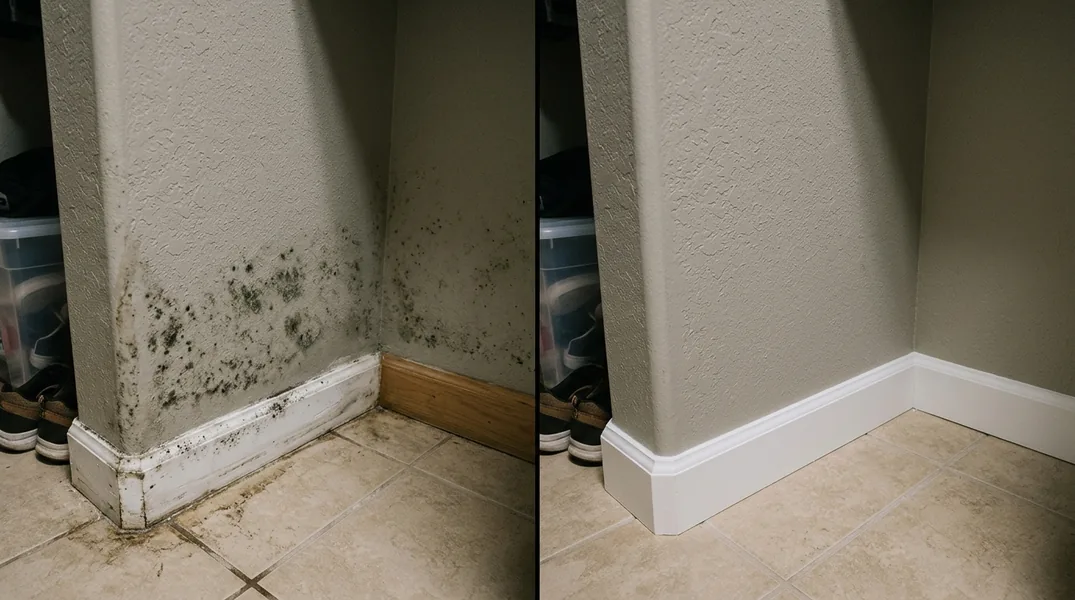
When you think of mold, you probably picture humid basements in the Pacific Northwest or the aftermath of a hurricane in Florida. The truth is that mold after water damage can take hold right here in the Valley of the Sun. The desert climate keeps outdoor humidity low most of the year, but that does not matter much once water gets trapped inside your home. Mold needs three things to grow: moisture, a food source (and drywall paper, wood framing, and carpet backing all qualify), and a temperature range that stays roughly between 60 and 80 degrees. Your air-conditioned house provides the temperature, your building materials provide the food, and a leak, a burst pipe, or an appliance failure provides the moisture. That is why mold after water damage is a real concern for homeowners in Phoenix and throughout the East Valley, not just in wetter parts of the country.
The other factor people underestimate is time. When we talk to homeowners about how fast does mold grow, the honest answer is that visible growth can appear in as little as 24 to 48 hours under the right conditions. That does not mean every spill turns into a mold problem, but it does mean that the clock starts ticking the moment water touches porous materials. The faster the water is removed and the structure is dried, the less opportunity mold has to establish itself. This is exactly why our first priority on any water damage call is Emergency Water Removal & Extraction, followed immediately by Water Mitigation & Structural Drying with documented moisture readings.
The 24 to 48 Hour Window: What Actually Happens Inside Your Walls
Water behaves differently depending on the materials it touches. Carpet and pad soak up water like a sponge, and if they stay wet, they create a humid microclimate underneath your feet. Drywall is even more concerning because its paper facing is a ready food source for mold, and water wicks upward through the gypsum core. Wood framing absorbs moisture slowly and releases it slowly, which means a wall cavity can stay damp for days or weeks after the visible water is gone. In a desert climate, the exterior of a home may dry quickly, but the inside of a wall assembly does not get the same airflow. That trapped moisture is where mold after water damage quietly begins.
This is why moisture readings matter so much. A restoration company that pulls equipment after two days without taking readings is guessing. A proper drying process involves taking readings at the start, logging them daily, and only removing equipment when the numbers show the materials have reached a dry standard. We document drying to IICRC S500 standards, which means the process is based on a published industry standard rather than a hunch. If you have had a leak and you are not sure whether the wall cavity is dry, a moisture inspection is the only way to know. You can call us at (623) 255-1819 to schedule an assessment.
Hidden Leaks and Slab Leaks: The Mold Risk You Cannot See
Some of the most stubborn mold problems we see in Mesa and Scottsdale start with water that was never visible on the surface. A slab leak, for example, is a pipe failure underneath your foundation. The water may travel through the slab and emerge at the base of a wall, under flooring, or in a closet, often after weeks of slow accumulation. By the time you notice a warm spot on the floor or a musty smell, mold may already be growing in the wall cavity or under the carpet. The same is true for a slow supply line leak behind a cabinet or a pinhole leak in a wall. These are classic hidden leak scenarios, and they are exactly the kind of loss that calls for Slab Leak & Hidden Leak Water Damage expertise: finding the moisture, mapping it with readings, and drying the structure before mold remediation becomes necessary.
It is important to say plainly that we do not repair the pipe itself. Plumbing repair is work for a plumber, and we coordinate with licensed plumbers when a leak needs to be fixed at the source. Our job is what happens after the water escapes: extraction, drying, and documenting the conditions so the repair and any mold work can be scoped correctly. If you suspect a hidden leak, the first step is a moisture inspection, not demolition. A small clean-water leak caught early may need only extraction and a few days of drying, and we will tell you that if it is the case.
Mold Remediation in Phoenix: What the Process Actually Looks Like
When mold is already present, the approach depends on the extent of the growth and the materials involved. In many cases, mold after water damage is surface-level on framing or drywall and can be addressed by removing the affected materials, cleaning the surfaces, and correcting the moisture source. In more extensive cases, containment and air filtration are used to keep spores from spreading to unaffected areas. We want to be clear about credentials here: mold work is carried out to the rules that apply in the state, and we do not claim a mold remediation license. Several states license mold assessment and remediation, and their rules differ. What we do is follow the applicable requirements and document the work. If you are searching for mold remediation in Phoenix, ask any company how they handle the assessment and the remediation, and make sure the moisture problem is being fixed, not just the visible mold.
It is also worth saying that mold is a building problem that follows moisture. It is not a reason to panic, and it is not a health diagnosis. If you have health concerns, those should be discussed with your doctor. What we can do is identify the moisture source, document the readings, and carry out the remediation and drying so the building is returned to a dry condition. We never promise that mold will never come back, because that depends on fixing the source. What we can promise is that the moisture source is addressed and the drying is verified with readings.
Emergency Water Removal & Extraction Near Me: When to Call a Pro
Not every water event requires a professional crew. A small, clean-water leak from a supply line that you catch within an hour and can dry with towels and a fan may be a DIY situation. But there are clear signals that you should call a professional for emergency water removal and extraction near me searches in Glendale or anywhere in the Valley. If the water has reached carpet and pad, if it has soaked into drywall, if it came from a sewage line or an appliance like a water heater, or if you cannot tell where the water came from, it is time to call. The category of the water matters: clean water from a supply line is different from gray water from a washing machine or black water from a sewage backup, and the cleanup process is different for each.
When you call Phoenix Water Damage Restoration, the process starts with an assessment. We identify the category and class of the water loss, take moisture readings, and give you a written scope before any work begins. We do not default to demolition. If drying is enough, we will say so. If reconstruction is needed, Water Damage Repair & Reconstruction is carried out by partner crews who hold whatever state or local license the work requires. We are fully insured, and we help document the loss with photos, readings, and a drying log. Coverage decisions are made by your insurance company. If you need a free estimate or just want to talk through what you are seeing, call (623) 255-1819. We will give you an honest read on whether you need a crew or a fan and a dehumidifier.
Looking for a professional water damage restoration contractor in Phoenix? Phoenix Water Damage Restoration responds fast for all your water damage restoration needs.
Get a Free Quote