



Commercial Water Damage Restoration in Phoenix
Commercial water damage restoration in Phoenix is a different animal from a house call. A burst supply line in a Midtown office tower, a failed water heater in a restaurant back-of-house, or a monsoon roof intrusion at a Scottsdale retail center means tenants, employees, inventory and revenue all stop at once. Phoenix spreads across the flat Salt River Valley in single-story stucco-and-tile commercial strips and newer two-story build-outs, with copper or PEX lines running under slab-on-grade floors and flat or low-slope roofs carrying AC units and condensate lines. When one of those lines lets go overnight, water spreads under tile, wicks up drywall and baseboards, and reaches tenant improvements next door before anyone unlocks the front door.
We are a local, independent restoration company serving the Valley since 2017. We extract, dry, document and rebuild what the water damaged, and we do it around your business hours and your tenants. Start with emergency water removal and extraction when the floor is still wet, or call (623) 255-1819 and we will walk the loss with you.
Why Commercial Water Losses Hit Harder in the Salt River Valley
Phoenix commercial buildings fail in specific ways. Hard water crusts water heaters and eats fittings in garages and utility closets. AC condensate lines clog and overflow into ceiling tiles above offices. Monsoon storms push rain sideways into low-slope roofs, roof drains and storefront walls, and the water shows up in a tenant space two suites away. Slab-on-grade floors hide leaks until the tile lifts or the baseboards swell, and by then the moisture has been feeding the wall cavity for days.
- Category 1 water from a clean supply line still becomes Category 2 within about 48 hours as it picks up soil, drywall paper and building dust.
- Category 3 water from a sewage backup or a monsoon ground intrusion requires containment, removal of porous materials and antimicrobial treatment before drying begins.
- Class 3 and Class 4 losses in commercial build-outs often involve water trapped under vinyl, tile or slab, which needs specialty drying and longer run times.
- Shared walls and common areas in multi-tenant buildings mean one leak becomes several claims unless the moisture boundary is mapped and documented early.
Naming the category and class before the first air mover starts is what separates a documented loss from a guess, and it is the first thing a property manager should ask any crew walking in the door.
Key info: A restaurant in Old Town Scottsdale lost a water heater overnight and the water ran under the kitchen tile into the dining room. Because the manager called before opening, we extracted, set containment at the kitchen line and dried the dining area with the doors open for lunch service. The tile and the subfloor were saved. The drywall toe-kicks were not, and we documented why.
For the code side of commercial rebuilds, the City of Phoenix Planning and Development Department publishes permit and inspection requirements at phoenix.gov/pdd, and it is worth knowing what triggers a permit before demolition starts.
How We Dry a Business Without Shutting It Down
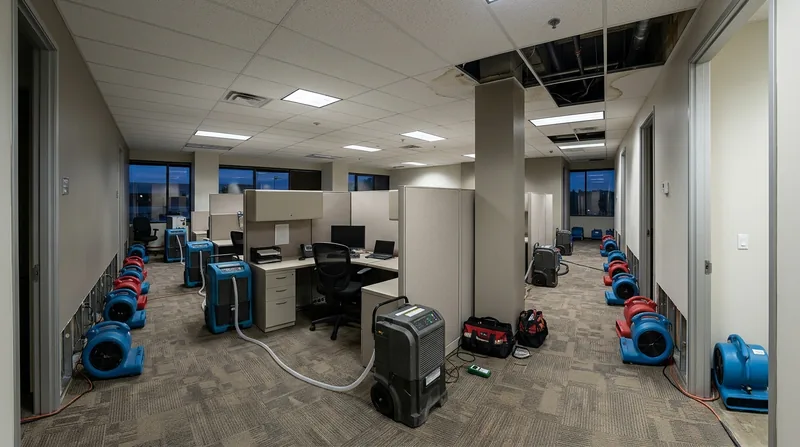
Commercial drying is a scheduling problem as much as a moisture problem. We map the loss with a moisture meter and a thermal imaging camera, name the category and class, and then build a drying plan around your operating hours. In an office building in the Camelback Corridor we can run desiccant or LGR dehumidifiers and air movers after hours and pull psychrometric readings each morning before staff arrive. In a retail unit in Chandler, we work aisle by aisle and keep the sales floor open.
- We walk the loss with the property manager or owner and photograph every affected room before anything moves.
- We take moisture readings at baseboards, toe-kicks, subfloor and ceiling, and log them on a drying log with temperature, relative humidity and grains per pound.
- We extract standing water and remove only the materials the readings say are saturated beyond drying, which may mean a flood cut at 12 or 24 inches rather than a full wall removal.
- We set containment and negative air where Category 3 water or mold risk is present, then place air movers and dehumidifiers sized to the class of the loss.
- We return daily, take readings, adjust equipment and send a written moisture report to the property manager.
- We remove equipment only when the readings meet the drying goal, and we write the scope of repair before any reconstruction starts.
Every step is documented to IICRC S500 standards, which means the drying log, not a calendar, decides when the job is done. For losses that spread across suites or floors, see our apartment, condo and HOA water damage page for how shared walls and common areas are handled.
Key info: A medical office in the 85004 zip code had a condensate line overflow above the ceiling grid over a weekend. We were on site before Monday opening, removed two saturated ceiling tiles, set a containment tent over the exam room, and dried the grid and insulation with the front desk open. The daily report went to the building manager and the tenant the same afternoon.
Commercial Drying Methods We Use on Valley Losses
The method follows the water, not the other way around. A clean supply line in a carpeted office calls for a different setup than a sewage backup in a restaurant or a monsoon intrusion under a slab in a warehouse. The table below shows how we match equipment and approach to the loss.
| Approach | Description | Best for |
|---|---|---|
| Extraction and low-profile drying | Portable extraction, air movers and LGR dehumidifiers sized to the square footage, with readings logged daily. | Category 1 supply line leaks in open office or retail space |
| Containment and negative air | Poly containment, HEPA vacuuming and antimicrobial treatment before drying begins. | Category 3 sewage backups and mold-affected tenant spaces |
| Specialty drying under hard surfaces | Floor drying mats and injection systems that pull moisture from subfloor and slab without full demolition. | Tile, laminate and vinyl over slab-on-grade in Phoenix commercial build-outs |
| Desiccant drying | High-volume desiccant dehumidifiers for large open volumes and deep-cavity assemblies. | Warehouses, hotels and restaurants with high ceilings and heavy evaporation load |
| Contents pack-out | Inventory, removal and off-site drying or cleaning of furniture, files and equipment. | Offices, clinics and retail units where contents block drying |
Equipment comes out when the readings say the drying goal is met, and the written drying log is what your property manager keeps on file.
Commercial Water Damage Restoration Cost in Phoenix: What to Expect
Commercial water damage pricing in Phoenix starts from $2,500 for a small, clean-water loss that needs extraction and a few days of drying in a single suite. From there, the number moves with the category of water, the class of the loss, the square footage, the materials affected and whether reconstruction is involved. A Category 3 sewage backup in a restaurant kitchen costs more than a Category 1 supply line leak in a carpeted office, even when both cover the same square footage.
- Category of water drives the safety setup: Category 3 losses require containment, removal of porous materials and antimicrobial treatment.
- Class of loss drives equipment count and drying days: a Class 4 slab or cavity loss runs longer than a Class 1 open space.
- Materials matter: carpet and pad are often removed, tile and slab need specialty drying, and drywall may need a flood cut.
- Access and hours affect labor: after-hours work and tight tenant spaces cost more than an empty warehouse.
- Reconstruction scope is written after drying and priced separately, so you are not paying for demolition you did not need.
Getting two or three written estimates is smart on any commercial loss, and it is worth asking each company for the moisture readings, the category and class, and a written scope before you sign. Our full pricing overview shows the ranges by service, and the estimate itself is free.
Coverage decisions are made by your insurance company. We document the loss with photos, moisture readings, a drying log and a written scope, and that documentation is what you hand to your carrier.
Commercial Water Damage Restoration Near Me: How to Vet a Company in Phoenix
Searching for commercial restoration services near me in Phoenix returns a long list, and most of it is a call center that sells your number to whoever answers. The company you want shows its process before you sign anything. Ask what equipment they will bring, whether they take readings and log them, and who writes the scope. Ask for proof of insurance and a certificate you can keep on file.
- Confirm the company is fully insured and ask for a certificate of insurance before work starts.
- Get two or three written estimates and compare the scope line by line, not just the total.
- Ask for references from property managers or business owners with a similar building type in the Valley.
- Ask whether the repair work requires a city permit, and who is pulling it. Reconstruction is carried out by partner crews who hold whatever state or local license the work requires.
- If your building is in an HOA or a multi-tenant property, confirm who approves access and where containment can go before the crew arrives.
Any restoration company, including us, should be willing to answer those questions in writing. If a crew starts pulling drywall before a moisture map exists, that is a red flag. Reach out through our contact page and we will walk your building with you.
What Comes After the Drying: Repair and Rebuild
Once the readings meet the drying goal, the repair scope begins. That can mean replacing drywall, baseboards, ceiling tiles, flooring or tenant improvements, and it is priced from a written scope rather than an hourly guess. If mold has started in a wall cavity or under a cabinet, mold work is carried out to the rules that apply in the state, and the moisture source is corrected first. For larger rebuilds, see our water damage repair and reconstruction page. The pipe or roof itself is fixed by a plumber or roofer we coordinate with, and we say so plainly.
Call (623) 255-1819 to schedule a walk-through. The phone is answered during the opening hours stated on the site, and the estimate is free.
Commercial Water Damage Restoration in Phoenix: Pricing Guide
| Service | Price | Details |
|---|---|---|
| Single-suite clean water loss | Starting at $2,500 | Extraction, air movers, dehumidifiers and daily moisture readings for a small Category 1 office or retail loss |
| Multi-suite or multi-floor drying | Starting at $6,500 | Containment, larger equipment count and daily written moisture reports across several tenant spaces |
| Category 3 sewage or flood cleanup | Starting at $9,500 | Containment, negative air, removal of porous materials and antimicrobial treatment before drying begins |
| Repair and reconstruction | On estimate | Drywall, flooring, ceiling and tenant improvements priced from a written scope after drying is verified |
| Travel | Included | in Phoenix and surrounding Valley cities, no separate call-out or mileage fee |
| Estimate | Free | On-site walk-through and written scope at (623) 255-1819, no obligation to book |
Indicative pricing, the exact cost depends on square footage, finish, and site access. Free personalized estimate within 24h at (623) 255-1819.