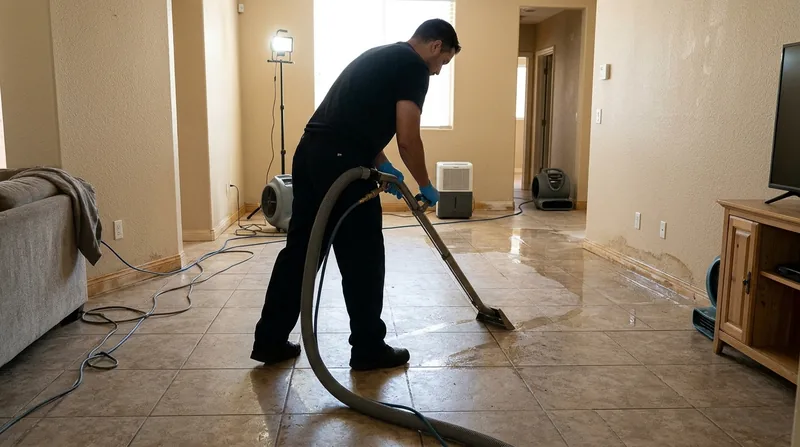




Emergency Water Removal & Extraction in Phoenix
When water is standing on your floor in Phoenix, water extraction in Phoenix is the first step that stops the damage from spreading. Phoenix spreads across the flat Salt River Valley in single-story stucco-and-tile ranches on slab-on-grade foundations, with copper or PEX lines running under the slab and water heaters sitting in garages crusted by hard water. That slab is unforgiving: water wicks sideways under tile and laminate, climbs the toe-kicks of cabinets, and soaks into baseboards before you see it. We pull standing water out with truck-mounted and portable extractors, clear tile, carpet and wood floors room by room, and log moisture readings from the first visit. If you are dealing with a slab leak or a hidden leak feeding the water, that is a related problem we handle separately, and you can read about it at slab leak and hidden leak water damage. The goal on day one is simple: get the water out, name the category and class of the loss, and start a drying log you can actually read.
Why Standing Water Is a Different Problem in Phoenix's Slab-on-Grade Homes
Most Phoenix homes sit on slab-on-grade foundations, and that changes how water behaves. There is no basement or crawl space to absorb a leak, so water spreads across the slab under tile, laminate and carpet, and it wicks up into drywall, baseboards and cabinet toe-kicks. The dry desert air helps with surface evaporation, but it does nothing for water trapped under flooring or inside a wall cavity. In mid-century red-brick ranches in Arcadia and Encanto, and in newer two-story stucco subdivisions with upstairs laundries, the failure mode is usually the same: a supply line, a water heater, an AC condensate line or an appliance hose lets go, and the water finds the lowest point.
- Water under tile and laminate keeps wicking into the subfloor and baseboards until it is extracted and dried.
- Upstairs laundry rooms in two-story subdivisions send water down through the ceiling assembly into the rooms below.
- Garage water heaters on hard water fail at the tank or the pan drain, and the water runs under the wall into the house.
- AC condensate lines clog in the summer and drip steadily into ceilings and closets for days before anyone notices.
Naming the category (clean, grey or black water) and the class of the loss on the first visit is what separates a documented job from a guess, and it drives every decision that follows.
Key info: A burst PEX line in a Gilbert two-story can put water through the upstairs laundry, the ceiling below and the hallway tile in under an hour. Extraction starts on the wet surfaces, but the moisture map has to include the ceiling cavity and the wall behind the washer, or the job is only half done.
For the official consumer guidance on mold and moisture after a water loss, the EPA's Mold Course Introduction is a plain-language resource worth reading while the equipment is running.
How We Remove Standing Water in Phoenix, Step by Step
Emergency water removal is a sequence, not a single pass with a wet vac. We start by stopping the source (you or your plumber close the valve), then we map the moisture with a meter and a thermal imaging camera before any equipment goes down. Extraction comes next, room by room, and then the drying setup is sized to the class of the loss. Every step is logged, and equipment comes out only when the readings say the drying goal is met.
- We confirm the water source is stopped and identify the category of water before extraction begins.
- We map moisture with meters and thermal imaging, then write the class of the loss into the scope.
- We extract standing water with truck-mounted units and portable extractors, including under toe-kicks and along baseboards.
- We set air movers and LGR dehumidifiers sized to the square footage and the evaporation load.
- We take psychrometric readings (temperature, relative humidity, grains per pound) and record them on a drying log.
- We return to check readings, adjust equipment, and remove it only when the materials are dry to the meter.
The written scope, the photos and the drying log are yours, and they are what your insurance company reviews when coverage is discussed.
Key info: A small clean-water leak from a refrigerator line in a Chandler kitchen may need only extraction and two to three days of drying. A Category 3 sewage backup in a Phoenix condo needs containment, removal of affected materials and a flood cut. We say which one you have before we start, and demolition is never the default.
If the loss is larger than one room, or the water came in from a monsoon storm, the next phase is water mitigation and structural drying, where the drying log and moisture mapping carry the job to the finish line.
Extraction Methods We Use in Phoenix Homes
The method follows the material and the volume of water. Truck-mounted extraction is the workhorse for carpet and large areas, while portable units reach upstairs laundry rooms, condos in Midtown and the Biltmore, and tight cabinet runs. We match the tool to the surface so the flooring has the best chance of being saved.
| Approach | Description | Best for |
|---|---|---|
| Truck-mounted extraction | High-volume vacuum unit that pulls standing water and water from carpet and pad quickly. | Carpeted rooms, hallways and larger losses where the water volume is high. |
| Portable extractor | Smaller unit that reaches upstairs, closets and cabinet toe-kicks. | Upstairs laundry rooms, condos and tight spaces the truck cannot reach. |
| Weighted extraction and floating | Water is pulled from carpet and pad while the floor is lifted to dry underneath. | Carpet that can be saved and pad that needs replacement. |
| Containment and negative air | Plastic barriers and HEPA-filtered negative air units isolate the affected area. | Category 3 water, sewage backups and any loss with mold concerns. |
| Flood cut and cavity drying | Drywall is cut at a controlled height to open the wall cavity for drying. | Wet insulation and framing behind baseboards that meters show is saturated. |
Emergency Water Removal & Extraction Cost in Phoenix: What to Expect
Water extraction pricing in Phoenix starts from $500 for a small, contained clean-water loss, and the number moves with the category of water, the class of the loss, the square footage and the materials involved. A single room of wet carpet is one job; a Category 3 sewage backup that needs containment, removal and a flood cut is another. We write the scope before the work, so you see what is included and what is not. Getting two or three estimates is smart, and comparing them line by line (extraction, drying equipment, monitoring visits, demolition, rebuild) tells you more than the bottom line. Coverage decisions are made by your insurance company, and we help document the loss with photos, moisture readings and a drying log.
For a fuller breakdown by service and loss type, see the full pricing overview.
Emergency Water Removal & Extraction Near Me: What to Check Before You Hire in Phoenix
Searching for water removal near me in Phoenix returns a long list of companies, and the differences matter when your floor is wet. Ask whether the company is fully insured, whether it takes moisture readings and keeps a drying log, and whether it writes a scope before any demolition. Ask for references from jobs like yours, and check them. If your home is in an HOA, read the association rules on contractor access and work hours before the crew arrives. Permits for reconstruction are handled by the partner crews who hold the license the work requires, and we tell you plainly when a plumber or roofer is the right trade for the source. You can reach us through the contact page to set up an estimate.
What to expect from any restoration company, including us: readings taken and logged, the category and class named, equipment removed only when the numbers say so, photos at every step, and a written scope before any rebuild. If a company cannot show you a drying log, that is your answer.
Emergency Water Removal & Extraction in Phoenix: Pricing Guide
| Service | Price | Details |
|---|---|---|
| Small clean-water loss (one room) | Starting at $500 | Includes extraction, initial moisture map and setup for a contained Category 1 loss in one room. |
| Multi-room extraction and drying | Starting at $1,200 | Includes extraction across several rooms plus air movers and dehumidifiers sized to the class of loss. |
| Category 3 sewage cleanup | On estimate | Requires containment, removal of affected materials and antimicrobial work, so the scope is written on site. |
| Travel | Included | in Phoenix and surrounding areas, no separate call-out or mileage fee |
| Estimate | Free | Written scope at (623) 255-1819, no obligation to book |
Indicative pricing, the exact cost depends on square footage, finish, and site access. Free personalized estimate within 24h at (623) 255-1819.