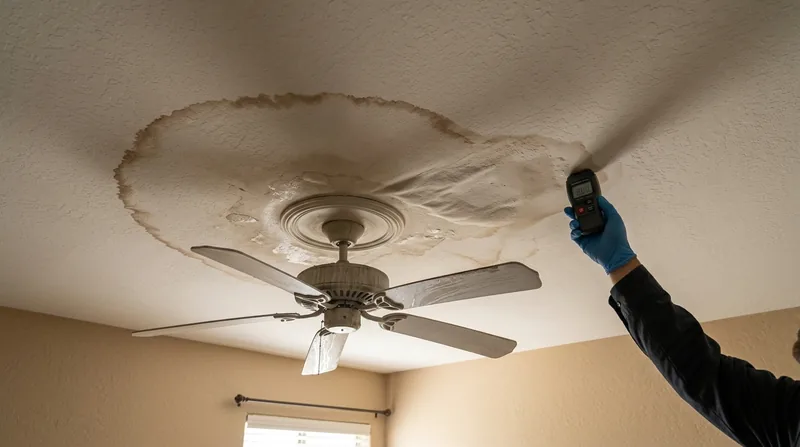




Brown rings on the ceiling above a hallway in a 1970s ranch off 32nd Street and Camelback usually trace back to one of three things: a condensate line from the AC unit in the attic, a roof or flashing leak after a monsoon, or a bathroom above in a newer two-story stucco build in Gilbert or Chandler. If you are searching for ceiling water damage repair in Phoenix, the first job is not patching drywall, it is finding the source and drying the attic side before anything gets closed up. We are a local, independent restoration company, fully insured, and we have been documenting drying to IICRC S500 standards since 2017. We take moisture readings, name the category and class of the water, and keep a written drying log until the numbers say the framing is dry. If you also have water on the floor, see our emergency water extraction service for the first step.
Why Ceiling Water Damage in Phoenix Rarely Fixes Itself
Phoenix is a flat valley of slab-on-grade stucco ranches and low-slope roofs carrying AC units and condensate lines, and the ceiling is where those failures show up first. The dry heat pulls moisture up into the attic, so a slow AC condensate drip or a monsoon-driven roof leak can stain a ceiling for weeks before it drips. Textured drywall in white, greige, soft gray, pale blue, sage or warm beige hides the first rings well, which is why homeowners often find soft drywall only after it sags.
- AC condensate lines and drain pans overflow into the attic and wick through the ceiling drywall.
- Monsoon wind-driven rain pushes under tile and flashing on low-slope roofs, especially in Arcadia and Encanto red-brick ranches.
- Upstairs bathrooms and laundries in newer two-story subdivisions in Gilbert, Chandler and Peoria leak into the ceiling below.
- Water heaters in garages crusted by hard water fail at the pan or T&P valve and send water into adjacent ceilings.
Each of these is a Category 1 or Category 2 loss until it sits, and the ceiling cavity is the last place a homeowner looks.
Key info: A ceiling stain in a Phoenix ranch home above an AC closet is often a condensate issue, not a roof issue. We read the attic side with a moisture meter and thermal camera before anyone cuts drywall. For roof-driven intrusion, the roofer fixes the roof and we dry and repair what the water damaged; see our roof leak and storm water intrusion page.
If you want an official reference on how building permits work for the repair side in Phoenix, the city's Planning and Development Department publishes the permit and inspection requirements that apply to structural and drywall work.
How We Find the Source and Dry a Wet Ceiling in Phoenix
Ceiling work starts with moisture mapping, not demolition. We read the attic side, the ceiling drywall and the framing with a moisture meter and a thermal imaging camera, then take psychrometric readings (temperature, relative humidity, grains per pound) to set a drying goal. If the water is Category 1 from a clean supply line, a small area may only need extraction and a few days of air movement. If it is Category 2 from an AC condensate pan or Category 3 from a sewage backup above, the scope changes.
- We stop the source with the plumber or roofer you or we coordinate with, because we do not repair the pipe or the roof itself.
- We map moisture in the ceiling cavity and attic framing and photograph the readings before any cut.
- We set containment and negative air where mold risk or dust is a concern, and HEPA vacuum the surfaces.
- We place air movers and LGR or desiccant dehumidifiers sized to the class of the loss, and log readings daily.
- We make a flood cut only when the drywall is saturated or sagging, and we dry the framing behind it.
- We remove equipment only when the drying log shows the framing and drywall have reached the drying goal.
- We write a scope for the ceiling repair and texture match before the rebuild starts.
The drying log and photos are yours, and they are the record if you need to document the loss for your insurance company. Coverage decisions are made by your insurance company.
Key info: In a Midtown condo tower, a supply line to an upstairs unit can wet the ceiling of the unit below. We work with the HOA and both owners to document the source and the readings, and the parties and their insurers decide responsibility. See our apartment, condo and HOA water damage page.
Ceiling Drying and Repair Methods We Use in Phoenix
The method follows the category of water and the class of the loss, not a package. A Class 1 ceiling leak with a small wet area dries differently from a Class 4 loss where water has soaked into plaster, brick or a low-permeability assembly in an older Arcadia home.
| Approach | Description | Best for |
|---|---|---|
| Targeted drying (no cut) | Air movers and dehumidifiers on a small wet area, readings logged daily. | Class 1 clean-water ceiling stains caught early. |
| Flood cut and cavity drying | Removal of saturated drywall, drying of framing, then patching and texture match. | Sagging drywall or Class 2 and 3 losses above the ceiling. |
| Containment and negative air | Sealed work area with HEPA filtration and antimicrobial where appropriate. | Sewage-affected ceilings or visible mold growth. |
| Ceiling rebuild and texture match | Drywall, tape, texture and paint to match the existing Phoenix interior. | Any ceiling opened for drying or damaged by water. |
Ceiling Water Damage Repair Cost in Phoenix: What to Expect
Most ceiling water damage repair in Phoenix starts from $350 for a small, contained area where the source is already fixed and drying is straightforward. From there, the cost depends on how much drywall has to come out, whether the attic side needs drying, whether the texture is a heavy hand-applied finish common in mid-century ranches, and whether mold is present. A slab leak or hidden leak that has been running under a floor can add ceiling damage below it, and that changes the scope.
The honest way to price this is a written scope after moisture readings, not a number over the phone. A small clean-water stain may be a short drying job plus a patch and texture; a saturated ceiling with a flood cut, containment and rebuild is a different job. The category of water, the class of the loss, the materials and the square footage move the number more than anything else. Our pricing page lays out the ranges, and getting two or three local estimates on the same scope is smart.
What to Look for When Hiring Ceiling Water Damage Repair Near Me in Phoenix
When you search for ceiling water damage repair near me in Phoenix, the companies that answer are not all the same. A local, independent company shows you its process: moisture readings taken and logged, the category and class of the water named, a written drying log, and a written scope before any rebuild. A call center or a pay-per-call network sells your call to whoever buys it, and the crew that shows up may not have read a meter at your house.
- Ask whether the company is fully insured and request a certificate of insurance before work starts.
- Ask for moisture readings and a drying log, and expect equipment to stay until the numbers say the ceiling is dry.
- Get two or three estimates on the same written scope, not on a phone guess.
- Ask who pulls the permit if structural or drywall work requires one; reconstruction is carried out by partner crews who hold whatever state or local license the work requires.
- If you are in an HOA or a condo tower, ask how the company documents the source and coordinates with the board.
You can reach us at our contact page to schedule an estimate. The phone is answered during the opening hours stated on the site, and we do not promise an arrival time; we promise readings, a log and a scope.
Ceiling Water Damage Repair in Phoenix: Pricing Guide
| Service | Price | Details |
|---|---|---|
| Small ceiling stain, source fixed | Starting at $350 | Includes moisture readings, targeted drying and a patch with texture match on a small area. |
| Flood cut and cavity drying | Starting at $850 | Includes drywall removal, framing drying with air movers and dehumidifiers, and daily drying log. |
| Ceiling rebuild and texture match | On estimate | Depends on square footage, texture type and whether paint and trim are included in the scope. |
| Containment and mold-related ceiling work | On estimate | Requires an on-site look to size containment, negative air and HEPA vacuuming before any rebuild. |
| Travel | Included | In Phoenix and surrounding areas, no separate call-out or mileage fee. |
| Estimate | Free | Response within 24h at (623) 255-1819, no obligation to book. |
Indicative pricing, the exact cost depends on square footage, finish, and site access. Free personalized estimate within 24h at (623) 255-1819.