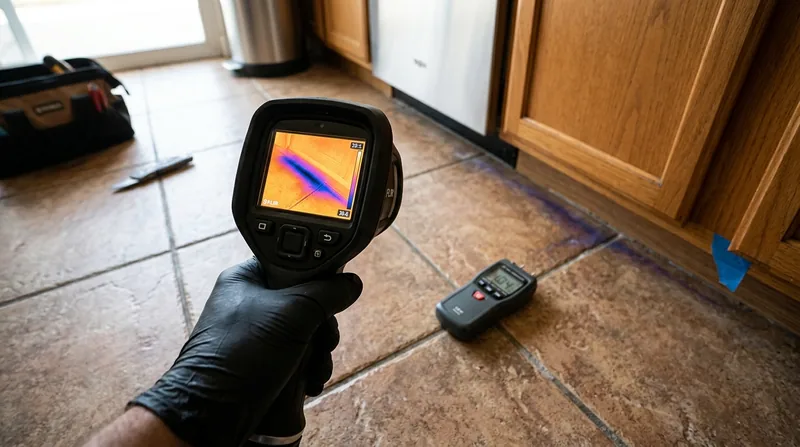




Phoenix sits on a flat slab of ancient lakebed and river gravel, and most of the Valley's homes are built slab-on-grade with copper or PEX water lines running directly under the concrete. That construction is efficient until a line fails beneath the floor. Slab leak repair in Phoenix starts with finding the water before anyone cuts concrete: warm spots on tile, a water meter that never stops spinning, baseboards that stay damp with no visible source. We trace hidden leaks with thermal imaging and moisture meters, dry the slab and the flooring above it, and coordinate the pipe repair with a plumber. Since 2017 we have documented drying to IICRC S500 standards on losses from Arcadia ranches to two-story stucco subdivisions in Gilbert. If you are watching a water bill climb for no reason, start with our water mitigation and structural drying process.
Why Hidden Leaks Under the Slab Hit Phoenix Homes So Hard
Phoenix's soil moves with the heat, and the hard water in the Valley is rough on copper. A pinhole in a line under a tiled hallway can weep for weeks before anyone notices, and by then the water has spread sideways under the slab, climbed into the baseboards, and wicked up into carpet pad and cabinet toe-kicks. The desert climate hides the evidence: low humidity pulls surface moisture away fast, so the floor feels dry on top while the slab stays wet underneath.
- A water meter that keeps turning with every fixture shut off is the clearest early signal of a hidden leak.
- Warm or hot spots on a tile floor often mean a hot-water line is leaking beneath the slab.
- Baseboards that stay soft or paint that bubbles along the bottom of a wall point to moisture wicking up from the slab.
- A musty smell in a closet, hallway, or laundry room with no visible water is worth a moisture meter reading.
- Unexplained jumps in the water bill in a Phoenix home usually trace back to a slab or irrigation line.
None of these signs means the floor has to come up. It means the leak needs to be found and the moisture mapped before anyone decides on demolition.
Key info: In a 1950s red-brick ranch in Encanto, a homeowner noticed a warm strip on the bathroom tile and a water bill up by 40 dollars. Thermal imaging traced a hot-water line leak under the slab. We dried the slab and the adjacent hallway flooring, and the plumber repaired the line through a small access point instead of a full floor tear-out.
For the plumbing side, the City of Phoenix requires permits for most water line work, and the Phoenix Planning and Development Department publishes the current requirements. We scope and document the water damage; the pipe itself is the plumber's work.
How We Find and Dry a Slab Leak in Phoenix Without Guessing
We start by confirming the source. A moisture meter and a thermal imaging camera let us see temperature differences and moisture patterns under tile, laminate, and carpet without opening the floor. We map the affected area, name the category and class of the loss, and log psychrometric readings (temperature, relative humidity, grains per pound) so the drying has a baseline. Only then do we set equipment.
- We interview you about the signs (warm spots, meter movement, damp baseboards) and shut off the water if the leak is active.
- We scan the floor with thermal imaging and confirm readings with a pin or pinless moisture meter.
- We map moisture across the slab, baseboards, and any flooring above it, and photograph each reading.
- We coordinate with a plumber for the pipe repair and keep our drying scope separate from that work.
- We extract standing water if any, then set air movers and LGR dehumidifiers sized to the class of the loss.
- We log readings daily and remove equipment only when the slab and materials meet the drying goal.
That written drying log is what separates a documented job from a crew that pulls equipment after two days because the floor looks dry.
Key info: A two-story stucco home in Chandler had an upstairs laundry and a slow supply line leak that ran down inside the wall to the first-floor ceiling. We traced it with thermal imaging, opened a controlled flood cut, dried the wall cavity and the subfloor, and documented each day's readings for the homeowner's records.
If the leak has already reached carpet or wood flooring, our floor and carpet water damage page covers what can be saved and what has to be replaced.
Slab Leak Detection Methods We Use in Phoenix
Not every hidden leak needs the same tool. The method depends on the flooring, the age of the home, and whether the leak is hot or cold water. Here is how the approaches compare on a Phoenix slab-on-grade home.
| Approach | Description | Best for |
|---|---|---|
| Thermal imaging scan | An infrared camera shows temperature differences under tile, laminate, or carpet without opening the floor. | Hot-water slab leaks and warm spots on tile. |
| Moisture meter mapping | Pin and pinless meters confirm moisture in the slab, baseboards, and subfloor and establish the boundaries of the wet area. | Cold-water leaks and any loss where the extent of moisture is unclear. |
| Psychrometric readings and drying log | Temperature, relative humidity, and grains per pound are logged daily to track the drying goal. | Every slab leak where drying equipment is set, and for documentation. |
| Controlled flood cut | A small, measured opening in drywall to inspect and dry a wall cavity when readings show moisture behind the wall. | Leaks that have traveled into walls or ceilings before discovery. |
| Plumber coordination | We document the water damage and coordinate the pipe repair with a licensed plumber; the pipe itself is not our scope. | Any confirmed slab leak that needs the line repaired or rerouted. |
Slab Leak Water Damage Cost in Phoenix: What to Expect
Water damage from a hidden leak is priced on the category of water, the class of the loss, the square footage affected, and the materials involved. A small clean-water leak caught early may need only extraction and a few days of drying, and we say so. A leak that has run under tile for weeks, soaked carpet pad, and wicked into cabinets is a larger scope. Our work starts from $395 for a documented assessment and initial drying setup, and the full scope is written before any rebuild.
- The category of water (clean, grey, or black) changes the handling and disposal requirements.
- The class of the loss (how much water and how much evaporation load) drives equipment count and drying days.
- Flooring type matters: tile and laminate may need controlled openings, while carpet and pad may be salvaged or replaced.
- Access to the affected area affects labor, especially in condos and HOA buildings with shared walls.
- Rebuild scope after drying is separate and is carried out by partner crews who hold the license the work requires.
Getting two or three estimates is smart on any slab leak loss. Ask each company how they will find the leak, whether they log readings, and what the written scope includes. Our pricing overview shows how the ranges break down.
Slab Leak Detection Near Me: What to Look for When Hiring a Restoration Company Near Phoenix
When you search for slab leak detection near me, the results can look the same. The difference is in the process. Ask whether the company is fully insured, whether it logs moisture readings and provides a written drying log, and whether it will name the category and class of the water. Ask for references from Phoenix-area jobs and confirm how it coordinates with a plumber. If your home is in an HOA, ask how the company handles shared-wall documentation and condo access. Coverage decisions are made by your insurance company, so the value a restoration company brings is documentation: photos, readings, and a written scope. Call Phoenix Water Damage Restoration at (623) 255-1819 to set up an assessment.
Slab Leak & Hidden Leak Water Damage in Phoenix: Pricing Guide
| Service | Price | Details |
|---|---|---|
| Slab leak detection and moisture mapping | Starting at $395 | Thermal imaging scan, meter readings, and a written moisture map of the affected area |
| Water extraction and initial drying setup | Starting at $650 | Extraction of standing water plus air movers and dehumidifiers sized to the class of loss |
| Structural drying with daily monitoring | From $1,200 | Daily psychrometric readings, drying log, and equipment adjustments until the drying goal is met |
| Controlled flood cut and cavity drying | On estimate | Measured drywall opening to dry a wall cavity; scope depends on how far the leak traveled |
| Complex or large-scale loss | On estimate | Multiple rooms, condo or HOA access, or Category 2 or 3 water needs an on-site scope first |
| Travel | Included | In Phoenix and surrounding areas, no separate call-out or mileage fee |
| Estimate | Free | Response within 24h at (623) 255-1819, no obligation to book |
Indicative pricing, the exact cost depends on square footage, finish, and site access. Free personalized estimate within 24h at (623) 255-1819.