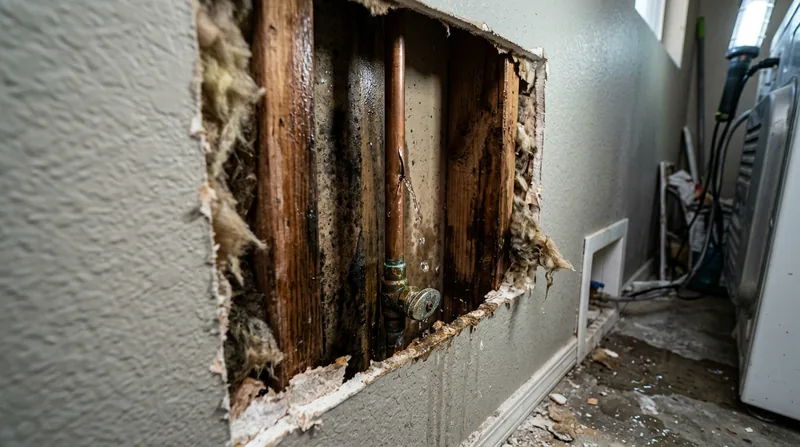




A split supply line under a slab in a 1970s ranch off Thomas Road, a failed PEX fitting behind the washing machine in a Gilbert two-story, or an old copper line that finally let go in an Arcadia red-brick ranch: burst pipe repair in Phoenix starts the moment the water is shut off, and what happens in the next few hours decides whether you are drying drywall or cutting it out. Phoenix sits on flat Salt River Valley ground, and most of the housing stock is stucco-and-tile on slab-on-grade foundations with copper or PEX running under the concrete. Water from a burst line has nowhere to drain in that construction, so it spreads sideways under tile and laminate, wicks up baseboards and toe-kicks, and climbs into the bottom plate of interior walls. We are a local, independent restoration company, fully insured, in business since 2017, and we document drying to IICRC S500 standards. We extract the water, map the moisture, dry the structure, and coordinate the plumbing repair with a plumber so the job closes in one sequence. If you are standing in water right now, call (623) 255-1819 and start with emergency water removal and extraction.
Why Burst Pipe Water Damage Hits Phoenix Homes Differently
Phoenix does not freeze like the Midwest, but the Valley gets just enough hard overnight cold in December and January to crack an exposed line, and the building stock makes the damage worse. Supply lines run through hot attics, garage walls and uninsulated exterior stucco, and water heaters sit in garages crusted by hard water. When a line lets go, the slab-on-grade floor holds the water in the living space instead of letting it drain down.
- Slab-on-grade construction traps water under tile and laminate, so it spreads across the room before you see it.
- Copper and PEX lines under the slab can fail quietly and surface as a hot spot or a buckling floor rather than a visible spray.
- Upstairs laundries in newer two-story subdivisions in Gilbert and Chandler send water down through the ceiling assembly into the first floor.
- Garage water heaters and their supply lines sit in the coldest part of the house and take the first hit on a freeze night.
- Monsoon season does not freeze pipes, but it drives roof and storm intrusion that often gets mistaken for a plumbing loss until we map the source.
Naming the category and class of the water on the first visit is what separates a documented dry-out from a guess, and it is the first thing we put in writing.
Key info: A burst line in a Sun City West ranch with a slab foundation is a Class 2 or Class 3 loss before you even see standing water, because the water has soaked into tile, baseboards and the wall cavity. The drying plan changes with the class, not with how wet the floor looks.
For the official position on permits and contractor requirements for the repair side of the job, homeowners can check the City of Phoenix Planning and Development Department before reconstruction begins.
How We Handle Burst Pipe Water Damage Repair in Phoenix, Step by Step
Every loss starts with the water shut off and the source confirmed. We walk the house with a moisture meter and a thermal imaging camera, take psychrometric readings (temperature, relative humidity, grains per pound), and write a scope of work before any material comes out. Demolition is never the default: a small clean-water leak caught early may need only extraction and a few days of drying, and we tell you that when it is true.
- We shut off the supply and confirm the source, then coordinate the plumbing repair with a plumber so the line is fixed before drying ends.
- We extract standing water with truck-mounted and portable units and check the slab and subfloor with a moisture meter.
- We map moisture room by room, photograph every reading, and name the category (1, 2 or 3) and class (1 to 4) of the loss in writing.
- We set air movers and LGR dehumidifiers, build containment where needed, and log readings daily against a stated drying goal.
- We cut a clean flood cut where drywall is wet above the baseboard, remove wet toe-kicks and baseboards, and HEPA vacuum and apply antimicrobial where the scope calls for it.
- We remove equipment only when the numbers say the structure is dry, then hand off a written scope for water damage repair and reconstruction.
That sequence is the same in a Midtown condo tower and a Cave Creek ranch, but the drying plan is not, because the evaporation load and the materials are different.
Key info: In a Tempe rental near the university, a failed supply line behind the washer soaked carpet, pad and the bottom plate of the wall. We extracted, pulled the pad, dried the carpet and framing to the log, and left the tile untouched. The plumber fixed the fitting the same day, and the tenant was back in the unit once the readings held.
When the source turns out to be under the slab rather than in a wall, the same crew follows the slab leak and hidden leak water damage process, because the drying strategy is different when the water is coming up through concrete.
Drying Approaches We Use for Burst Pipe Water Damage
The right approach depends on the class of the loss, the materials, and how far the water traveled. We choose the equipment mix from the readings, not from a package price, and we document the choice in the drying log.
| Approach | Description | Best for |
|---|---|---|
| Extraction and air movement | Truck-mount extraction, then air movers to drive evaporation from floors and walls. | Class 1 and Class 2 clean-water losses caught early. |
| LGR dehumidification | Low-grain refrigerant units pull moisture from the air while the space stays closed. | Class 2 and Class 3 losses in slab homes with tile and drywall. |
| Desiccant drying | Desiccant units for tight, cool or hard-to-heat assemblies where LGR alone stalls. | Class 4 specialty drying, condo towers and enclosed wall cavities. |
| Flood cut and cavity drying | Clean cut above the wet line, baseboards and toe-kicks removed, cavity dried and logged. | Wet drywall, wicking bottom plates and upstairs laundry losses. |
| Containment and HEPA | Negative air and HEPA vacuuming where the water is grey or black or mold is suspected. | Category 2 and 3 water, sewage backups and long-standing leaks. |
Each of these is written into the scope with a drying goal, and the equipment comes out when the readings hit that goal.
Burst Pipe Water Damage Cost in Phoenix: What to Expect
Most homeowners want a number before they let anyone in the door, and the honest answer is a range. Emergency extraction and drying in a Phoenix home typically starts from $350 for a small, contained clean-water loss, and the figure moves with the category of water, the class of the loss, the square footage affected, and the materials involved. A burst line that soaked carpet and pad in one room is a different job from one that ran under tile across a slab ranch and climbed into three walls.
- Category of water moves the number most: clean supply-line water is Category 1, while a sewage backup is Category 3 and needs containment and disposal.
- Class of loss sets the equipment count and the days of drying, which is the biggest driver on a slab-on-grade home.
- Materials decide what can be dried in place and what has to be cut out, from carpet and pad to laminate, hardwood and drywall.
- Access matters in condo towers and Midtown buildings where equipment has to come up an elevator and containment protects neighboring units.
Getting two or three written estimates is smart, and so is asking each one to name the category and class and to show the moisture readings. The full pricing overview lays out the ranges in more detail, and we write a scope before any rebuild starts.
Burst & Frozen Pipe Water Damage Near Me: What Phoenix Homeowners Should Know Before Hiring
Searching for burst pipe water damage near me returns a mix of local companies, national franchises with a call center, and 800-number networks that sell your call to whoever buys it. The way to tell them apart is process, not branding. Ask what they will measure, what they will write down, and what they will remove, and get it in writing before equipment goes in the door.
- Confirm the company is fully insured and ask for a certificate before work starts.
- Get two or three written estimates and compare the scope, not just the total.
- Ask for references from jobs in Phoenix or a nearby city with the same construction as yours.
- Ask who pulls the permits for reconstruction, since partner crews hold whatever state or local license the work requires.
- In HOAs and condo associations, ask how the company handles containment and coordination with neighbors and the board.
What to expect from any restoration company, including us, is a written scope, photos, moisture readings and a drying log you can read. If a company pulls equipment after two days without numbers, that is the behavior to walk away from. You can contact us for a free estimate and we will tell you plainly if your loss is small enough to need only extraction and a few days of drying.
Burst & Frozen Pipe Water Damage in Phoenix: Pricing Guide
| Service | Price | Details |
|---|---|---|
| Emergency extraction and drying (small clean-water loss) | Starting at $350 | Includes extraction, moisture mapping and initial drying setup for one contained room. |
| Multi-room burst pipe dry-out | Starting at $1,200 | Covers air movers, LGR dehumidifiers and daily drying logs across several rooms. |
| Flood cut and wall cavity drying | Starting at $2,500 | Includes clean flood cut, baseboard removal and cavity drying with documented readings. |
| Category 3 or sewage-contaminated loss | On estimate | Containment, HEPA vacuuming and disposal drive the scope, so an on-site look comes first. |
| Reconstruction after drying | On estimate | Drywall, flooring and trim are scoped in writing after drying is verified and the plumber is done. |
| Estimate | Free | No-obligation written scope at (623) 255-1819, with readings and photos included. |
Indicative pricing, the exact cost depends on square footage, finish, and site access. Free personalized estimate within 24h at (623) 255-1819.