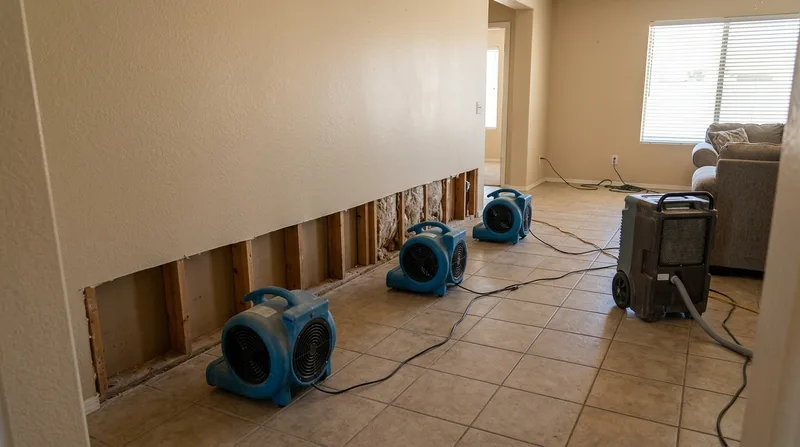




Water Mitigation in Phoenix: Drying What the Desert Heat Leaves Behind
Phoenix sits on a flat slab of the Salt River Valley, and most of its housing stock is stucco-and-tile ranches on slab-on-grade foundations with copper or PEX water lines running under the concrete. When one of those lines lets go, or a garage water heater with years of hard-water scale finally cracks, the water has nowhere to drain and starts wicking into baseboards, subfloor and the bottom plate of the walls. Water mitigation in Phoenix is the work of stopping that spread and drying the structure to a measured target, not just a visual one. We are a local, independent company, fully insured, and we have been drying Valley homes since 2017. Drying is documented to IICRC S500 standards, with moisture readings logged daily and equipment pulled only when the numbers say so. If you are standing in a wet hallway right now, start with emergency water removal and extraction, then we move straight into mitigation and structural drying.
Why Water Mitigation Matters in Phoenix's Slab-and-Stucco Housing Stock
Phoenix spreads across the flat Salt River Valley in single-story stucco-and-tile ranches on slab-on-grade foundations, newer two-story subdivisions with upstairs laundries, and mid-century red-brick ranches in Arcadia and Encanto. That building stock creates a specific set of water problems. A slab leak under a tile floor can run for weeks before anyone notices a warm spot or a spike on the water bill. An upstairs laundry supply line in a Gilbert two-story can soak the ceiling below and the wall cavity behind it. A flat or low-slope roof carrying the AC unit and its condensate line can back up during a monsoon and send water down inside the wall. In every case, the water keeps moving until someone maps the moisture and starts drying.
- Slab-on-grade foundations trap water under tile and laminate, so moisture mapping with a thermal imaging camera matters more than what the surface looks like.
- Stucco exteriors and textured drywall hold water in the wall cavity, and wicking climbs baseboards and toe-kicks faster than most homeowners expect.
- Hard water in the Valley shortens the life of water heaters and appliance supply lines, which is why garage and laundry leaks dominate the call volume.
- Monsoon storms push water against low-slope roofs and into desert-wash drainage, and interior roof leaks follow quickly.
None of this is exotic. It is the ordinary failure pattern of a desert city built on concrete, and it is exactly what structural drying is designed to handle.
Key info: A slow slab leak under a Chandler ranch can raise the water bill for a month before a tile grout line starts to darken. By then the subfloor and bottom plate have been wet for weeks, which is why we map moisture before we quote any drying scope.
For the official code side of rebuilding after a loss, the City of Phoenix Planning and Development Department publishes its permit and inspection information at phoenix.gov/pdd. That is where a homeowner can confirm what reconstruction work needs a permit before partner crews start closing walls.
How We Run Water Mitigation and Structural Drying in Phoenix
We start by naming the loss. Category 1 is clean water from a supply line, Category 2 is grey water from an appliance or a washing machine discharge, and Category 3 is black water from a sewage backup or a monsoon flood that crossed ground. Class 1 through 4 describes how much water and how much evaporation load the structure carries. Those two labels decide the equipment count, the containment plan and the drying goal. Then we map moisture with a meter and a thermal imaging camera, set air movers and dehumidifiers, and write a drying log every day until the readings hold.
- We stop the source or confirm it is stopped, then extract standing water before anything else.
- We take moisture mapping readings at baseboards, toe-kicks, subfloor and wall cavities, and photograph each one.
- We set air movers and LGR or desiccant dehumidifiers sized to the class of the loss, and record psychrometric readings (temperature, relative humidity, grains per pound).
- We check the drying log daily and adjust equipment placement as the numbers move.
- We remove equipment only when the moisture meter and psychrometric readings hit the drying goal for the material.
- We write the scope of work for any repair, and partner crews handle reconstruction under whatever license the work requires.
That process is the difference between drying a structure and hoping it dries.
Key info: A burst supply line in a Scottsdale two-story soaked the upstairs laundry and the ceiling below. We mapped moisture in both rooms, set containment and negative air in the laundry, dried the ceiling cavity for four days, and pulled equipment only when the meter matched the dry standard. No flood cut was needed because the readings said so.
If the loss is in a specific part of the Valley, start with the zone page closest to you, for example water mitigation and structural drying in Scottsdale (85251).
Drying Approaches We Use on Phoenix Losses
Not every loss gets the same equipment set. A clean supply-line leak in a Tempe condo may need only extraction and a few days of air movement. A Category 3 sewage backup in a Phoenix ranch needs containment, removal of affected porous material, antimicrobial application and a longer drying cycle. The table below shows how we match the approach to the loss.
| Approach | Description | Best for |
|---|---|---|
| Extraction plus air movers | Standing water removed, then high-velocity air movers dry surfaces and open cavities. | Category 1 leaks caught early, Class 1 and 2 losses. |
| LGR dehumidification | Low-grain refrigerant units pull moisture from the air while air movers keep it evaporating. | Class 3 and 4 losses, wall cavities and subfloor drying. |
| Containment and negative air | Plastic barriers and HEPA-filtered negative air keep dust and spores out of clean rooms. | Category 2 and 3 losses, sewage backups, mold-related work. |
| Flood cut and cavity drying | Drywall cut at a measured line so air can reach wet framing and insulation. | Wet wall cavities behind stucco and textured drywall, Class 3 losses. |
| Desiccant drying | Desiccant dehumidifiers handle deep drying loads where LGR units are not enough. | Large commercial losses and deep cavity drying in Phoenix. |
Each of these approaches is chosen from the moisture mapping and the class of the loss, not from a default script.
Water Mitigation & Structural Drying Cost in Phoenix: What to Expect
Water mitigation and structural drying in Phoenix starts from $1,250 for a small, clean-water loss that needs extraction and a few days of drying. That figure moves with the category of water, the class of the loss, the square footage affected and the materials involved. A Category 1 leak in a Peoria bathroom is a different job from a Category 3 sewage backup in a Phoenix ranch with tile and subfloor removal. The written scope and the drying log are what make the number defensible, and we document both before any repair quote is discussed.
- The category of water (clean, grey or black) changes the containment and material removal requirements.
- The class of the loss (1 through 4) sets the equipment count and the number of drying days.
- Materials matter: carpet and pad dry differently from tile over slab, laminate or hardwood.
- Access and square footage decide how much equipment and labor the job needs.
Getting two or three estimates on a mitigation scope is smart, and the comparison should be on readings and scope, not just the bottom line. Our full pricing overview is at phoenix-water-damage-restoration.com/pricing.
Key info: A small clean-water leak from a refrigerator line in a Glendale kitchen often needs only extraction and three to four days of drying. A monsoon roof leak that soaked a ceiling and a wall cavity in Mesa is a larger scope, and the estimate reflects the containment and cavity drying it needs.
What to Look for When Hiring a Water Mitigation Company Near Phoenix
When you search for a water mitigation company near Phoenix, the first thing to check is whether the company shows its process. Ask for moisture readings, the category and class of the loss, and a written drying log. Ask whether the crew is fully insured and whether reconstruction is done by partner crews who hold the license the work requires. Ask for references from similar losses in your part of the Valley.
- Confirm the company is fully insured and ask for a certificate before work starts.
- Get two or three written estimates and compare the scope and the readings, not just the price.
- Ask for references from recent jobs in Phoenix, Mesa, Glendale or wherever your home is.
- Ask who handles permits for any reconstruction, and whether your HOA or condo association has its own requirements.
- Be wary of any company that pulls equipment after two days without showing you numbers.
Coverage decisions are made by your insurance company, and we help document the loss with photos, moisture readings, a drying log and a written scope. To set up an estimate, reach us at phoenix-water-damage-restoration.com/contact or call (623) 255-1819.
Water Mitigation & Structural Drying in Phoenix: Pricing Guide
| Service | Price | Details |
|---|---|---|
| Small clean-water loss (Category 1) | Starting at $1,250 | Extraction plus three to four days of air mover drying, with daily moisture readings logged. |
| Wall cavity and subfloor drying | Starting at $2,400 | Includes LGR dehumidification and cavity drying; moves up with square footage and access. |
| Category 2 or 3 loss with containment | Starting at $3,800 | Containment, negative air, antimicrobial and affected material removal drive the higher scope. |
| Commercial or large-loss drying | On estimate | Desiccant drying and multi-zone equipment plans need an on-site look before a number is given. |
| Travel | Included | In Phoenix and surrounding areas, no separate call-out or mileage fee. |
| Estimate | Free | Written scope and moisture readings provided, no obligation to book the drying work. |
Indicative pricing, the exact cost depends on square footage, finish, and site access. Free personalized estimate within 24h at (623) 255-1819.