



Floor & Carpet Water Damage in Phoenix
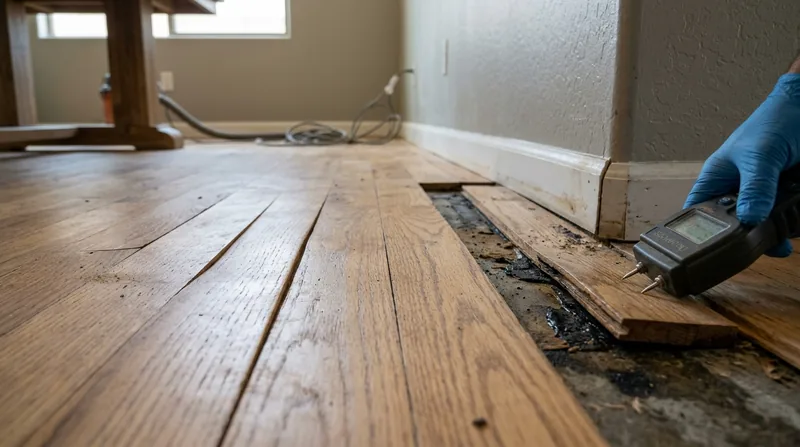
Phoenix sits on a flat slab-on-grade valley where most homes are single-story stucco-and-tile ranches with copper or PEX lines running under the concrete. When a supply line lets go or an AC condensate line clogs, the water spreads across the slab and straight into the carpet, pad, laminate, or hardwood before anyone notices. Carpet water damage in Phoenix is rarely just a wet rug problem: the slab holds the moisture, the pad wicks it upward, and the subfloor and baseboards soak it up from below. We check the subfloor and slab first, then decide per flooring type what can be dried and what has to come out. Call (623) 255-1819 and we will tell you what the readings say.
Why Phoenix Flooring Fails Differently Than Anywhere Else
The Salt River Valley's hard water, monsoon humidity swings, and slab-on-grade construction create a specific failure pattern. Water heater failures in garages and upstairs laundry closets in the newer two-story subdivisions in Gilbert and Chandler dump gallons onto carpet and laminate in minutes. In Arcadia and Encanto, the mid-century red-brick ranches have original hardwood over sleepers, and a slow slab leak can cup those boards for weeks before a homeowner sees a stain. The dry desert air pulls moisture out of the surface fast, which fools people into thinking the floor is dry when the subfloor and pad are still soaked.
- Carpet and pad trap water against the slab, so the pad has to be pulled and the concrete tested with a moisture meter before anyone calls it dry.
- Laminate swells at the seams and does not come back, so we document the damage and remove only the affected planks.
- Hardwood cups and crowns when the moisture differential between face and back is high, and some boards can be dried in place with mats and controlled airflow.
- Tile and grout stay intact, but the thinset and subfloor underneath hold water that only a thermal camera finds.
Every one of these decisions comes from a reading, not a guess, and we log the numbers as we go.
Key info: A homeowner in Mesa called after a water heater in the garage let go overnight. The carpet in the adjacent hallway looked dry on top. Our meter showed the pad at 28% moisture content and the slab at 19% under it. The carpet was saved, the pad was replaced, and the hallway dried in four days with readings documented each day.
The Arizona Registrar of Contractors publishes residential remodeling and repair guidelines that apply to any rebuild after water damage: roc.az.gov.
How We Dry Floors and Carpet in Phoenix Homes
We start by naming the water: Category 1 (clean supply line), Category 2 (grey, like a washing machine discharge), or Category 3 (black, like a sewage backup). Then we map the moisture with a meter and thermal camera, set the drying goal, and build the drying plan around the flooring type and the class of the loss. Air movers and LGR dehumidifiers go in, and we take psychrometric readings (temperature, relative humidity, grains per pound) daily. Equipment comes out when the numbers say the floor and subfloor have reached the drying goal, not on a fixed clock.
- We extract standing water and pull the carpet back to inspect the pad and subfloor.
- We take moisture readings on the slab, subfloor, baseboards, and toe-kicks and log them in a written drying log.
- We set air movers and dehumidifiers sized to the class of the loss and the square footage.
- We check the readings each day and adjust the equipment until the drying goal is met.
- We give you a written scope before any rebuild, including what partner crews will handle.
If the loss is Category 3, we contain the area with negative air and HEPA vacuum before we touch anything else, and we coordinate with a plumber on the source.
Key info: A Chandler two-story home had an upstairs laundry supply line fail and water ran through the ceiling into the downstairs carpet. We dried the carpet in place after extraction, flood-cut the ceiling drywall below the wet zone, and had the downstairs dry in five days. The upstairs subfloor was checked with a pin meter and a thermal camera before the ceiling was closed.
If the water came from a slab or hidden leak, see our slab leak and hidden leak water damage page for how we find moisture under the concrete.
Flooring Types and How We Handle Each One
No two flooring materials dry the same way, and the wrong approach turns a saveable carpet into a tear-out or a cupped hardwood into a full replacement. This table shows the approach we use for each floor type we see across Phoenix, Scottsdale, Glendale, and Tempe.
| Approach | Description | Best for |
|---|---|---|
| Extract and dry carpet in place | Weighted extraction, pad removal, air movers under the carpet, daily moisture checks. | Category 1 or 2 water caught within 24 to 48 hours. |
| Replace pad, save carpet | Pull and discard the soaked pad, dry the subfloor, install new pad and re-stretch. | Carpet that delaminated or has a soaked pad underneath. |
| Dry hardwood in place | Drying mats and controlled airflow on cupped boards, moisture readings on face and back. | Cupped hardwood with no structural damage to the subfloor. |
| Remove and replace laminate | Document swelling at the seams, remove affected planks, dry the subfloor before reinstall. | Laminate that has swelled and will not lay flat again. |
| Dry subfloor and slab | Air movers and dehumidifiers directed at the subfloor, moisture meter readings until the goal is met. | Any loss where the slab or subfloor is wet under the flooring. |
The flooring decision is always made from the readings, and we tell you plainly when a floor can be saved and when it cannot.
Floor & Carpet Water Damage Cost in Phoenix: What to Expect
Pricing for floor and carpet water damage in Phoenix depends on the category of water, the class of the loss, the square footage affected, and the flooring type. A small clean-water leak from a supply line under a bathroom vanity in a Sun City West ranch might need extraction, a few air movers, and three days of drying. A Category 3 sewage backup in a Phoenix condo with carpet through three rooms is a different scope entirely. Our starting point is From $395 for the initial extraction and moisture assessment, and the written scope you get before any rebuild tells you what the rest will run.
- The category of water (clean, grey, or black) drives whether carpet and pad can be saved or must be removed.
- The class of the loss (how much water and how much evaporation load) sets the equipment count and drying days.
- Square footage and the number of rooms affected move both the drying and the rebuild numbers.
- Flooring type matters: hardwood drying in place costs less than a full replacement, but takes more monitoring.
Getting two or three written estimates is smart, and any honest scope will list the readings and the drying goal before it lists the price. Our full pricing overview breaks down the ranges by service.
Floor & Carpet Water Damage Near Me: What to Look For in a Phoenix Restoration Company
When you search for floor and carpet water damage near me in Phoenix, the results are a mix of local companies, national franchises, and pay-per-call networks that sell your number to whoever buys it. Here is what to check before you let anyone start pulling carpet.
- Ask whether the company is fully insured and can produce a certificate of insurance on request.
- Ask for a written scope and a drying log before work starts, not after.
- Ask how they check a subfloor for moisture and whether they use a meter and a thermal camera.
- Ask whether they will tell you when a floor does not need to be replaced.
- Check references from jobs in your part of the Valley, and confirm who will do any reconstruction and under what license.
We are a local, independent company, fully insured, in business since 2017, and we document drying to IICRC S500 standards. Reach us through our contact and free estimate page to set up a walkthrough.
Floor & Carpet Water Damage in Phoenix: Pricing Guide
| Service | Price | Details |
|---|---|---|
| Carpet extraction and assessment | Starting at $395 | Includes weighted extraction, moisture readings on carpet, pad, and subfloor, and a written drying plan. |
| Pad replacement and carpet re-stretch | Starting at $2.50 per square foot | Covers pad removal and disposal, subfloor drying verification, new pad, and re-stretch of saved carpet. |
| Hardwood drying in place | On estimate | Requires on-site moisture mapping of face and back of boards plus subfloor readings before a number is given. |
| Laminate or tile removal and subfloor dry | On estimate | Scope depends on square footage, subfloor condition, and whether the water reached the slab. |
| Travel | Included | In Phoenix and surrounding areas, no separate call-out or mileage fee. |
| Estimate | Free | Response within 24h at (623) 255-1819, no obligation to book. |
Indicative pricing, the exact cost depends on square footage, finish, and site access. Free personalized estimate within 24h at (623) 255-1819.