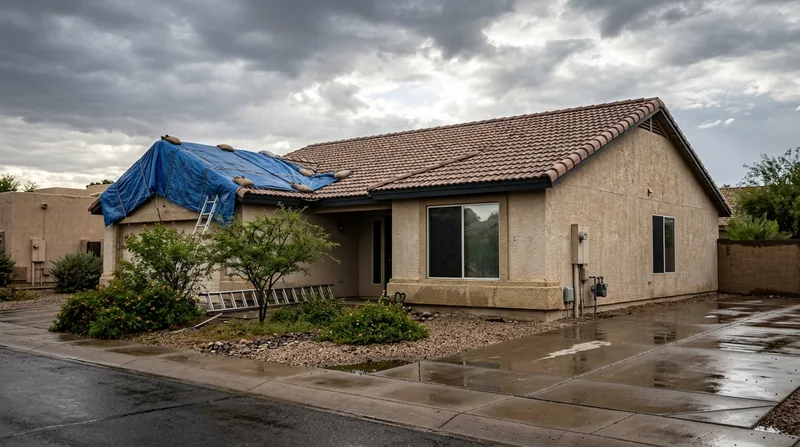




Roof Leak & Storm Water Intrusion in Phoenix
When a monsoon hits the Salt River Valley, the wind arrives before the rain and lifts tiles, ridge caps and flat-roof seams across Phoenix. Water then finds the path of least resistance: a cracked stucco corner, a failed pipe boot, a rusted AC curb, and minutes later it is dripping through your ceiling. Roof leak water damage in Phoenix is not a plumbing problem, it is an interior water problem, and the clock starts the moment the first stain spreads across the drywall. We are a local, independent restoration company working since 2017, fully insured, and we document every loss with moisture readings, thermal imaging and a written drying log. The roof itself gets fixed by a roofer we coordinate with. The water inside, the soaked insulation, the wicking drywall and the wet subfloor are ours. If the water is already through, see our ceiling water damage repair page for what happens next.
Why Roof Leaks Hit Phoenix Homes Harder Than Most Owners Expect
Phoenix roofs are built for sun, not for water. Tile roofs shed heat well but the underlayment bakes and cracks after years of 110-degree summers, and the first real monsoon rain pushes straight through it. Flat and low-slope roofs carry the AC units and condensate lines, and the seams and curbs around them are where water enters first. Stucco-and-tile ranches on slab-on-grade have no crawl space, so a ceiling leak soaks insulation, then the drywall, then the top plate, and the water runs down inside the wall cavity to the baseboards and the slab. In two-story subdivisions in Gilbert and Chandler, the upstairs laundry and the attic air handler sit directly above the rooms below.
- The monsoon season from June through September delivers the wind that lifts tiles and the rain that finds the underlayment.
- Flat-roof seams around AC curbs and condensate drains fail first because they hold standing water after every storm.
- Tile underlayment has a service life, and when it fails the leak shows up far from the broken tile.
- Slab-on-grade construction means water that enters the ceiling has nowhere to drain, so it spreads sideways through the insulation.
- Stucco walls wick water upward and hold it, which is why a ceiling stain often comes with a soft baseboard below.
Every one of these failure modes is a water damage problem before it is a roofing problem, and the interior damage is what grows if nobody dries it.
Key info: A homeowner in Arcadia called after a July storm because a brown ring had spread across the ceiling of a mid-century red-brick ranch. The tile looked fine from the ground. The thermal camera found wet insulation across a 6-foot span, and the moisture meter read elevated at the top plate. The roofer repaired a failed pipe boot; we dried the attic and the ceiling cavity before the drywall was closed.
For the official record of storm events and monsoon summaries in the region, the National Weather Service Phoenix office publishes them at weather.gov/psr.
How We Handle Storm Water Intrusion in Phoenix, Step by Step
Our process starts with the source, not with the shop vac. We walk the attic, the ceiling and the wall cavities with a moisture meter and a thermal imaging camera, and we name the category and class of the water before any equipment goes in. Rainwater that enters through a roof is typically Category 1 when it is fresh, but once it has run across attic insulation, dust and old underlayment, we treat it as Category 2 and adjust containment and antimicrobial use accordingly. Then we set drying equipment, log psychrometric readings (temperature, relative humidity and grains per pound) and remove nothing until the numbers say the assembly is dry to the drying goal.
- We stop the water entry with emergency roof tarping or temporary sealing where the roofer cannot get there the same day, so the interior drying is not fighting a live leak.
- We extract standing water and remove saturated insulation, ceiling drywall or baseboards only where the readings show it cannot be dried in place.
- We set air movers and LGR dehumidifiers, build containment where needed, and take moisture mapping readings at every visit.
- We log the drying progress daily and photograph every step, so you have a written record of what was wet and when it dried.
- We hand off the roof repair to a roofer and the rebuild to partner crews, with a written scope before any reconstruction starts.
That sequence is the same whether the loss is one ceiling in Tempe or a whole upstairs wall in a Gilbert two-story, and it is what separates documented drying from a crew that pulls equipment after two days without a number to justify it.
Key info: After an August storm in Mesa, water came through a flat-roof seam above a hallway and ran into the AC closet. We tarped the roof, extracted the ceiling cavity, set two LGR dehumidifiers and nine air movers, and logged readings for four days. The drying goal was met before the drywall was replaced, and the homeowner had photos of every reading for their records.
If the loss is bigger than one ceiling, our monsoon flood cleanup page covers standing water, storm-driven intrusion and the larger structural drying that follows.
Approaches We Use for Roof Leak and Storm Water Intrusion
The right approach depends on where the water entered, how far it traveled and what it soaked. A ceiling stain with no attic involvement is a different loss from a wall cavity that has been wicking for a week. We choose the method after the readings, not before.
| Approach | Description | Best for |
|---|---|---|
| Emergency roof tarping and temporary sealing | We cover the failed area so the interior drying is not fighting an active leak, and document the source for the roofer. | Active leaks during a monsoon when the roofer cannot get there the same day. |
| Ceiling and attic cavity drying | Air movers and LGR dehumidifiers dry the insulation, top plate and ceiling cavity without a full tear-out where readings allow. | Fresh ceiling stains with wet insulation but sound drywall. |
| Flood cut and wall cavity drying | We remove the lower drywall where water has run inside the wall, dry the framing and subfloor, and document the cut line. | Stucco walls that have wicked water to the baseboards and slab. |
| Containment and antimicrobial treatment | We build containment and use negative air where the water is Category 2 or 3, and apply antimicrobial to affected framing. | Rainwater that ran across attic dust, insulation and old underlayment. |
| Moisture mapping and thermal imaging | We map the wet area with a meter and a thermal camera, then log readings until the drying goal is met. | Every loss, and especially hidden travel behind stucco and tile. |
Each method comes with readings before and after, so the scope is written from data and not from a guess.
Roof Leak & Storm Water Intrusion Cost in Phoenix: What to Expect
Interior storm water drying in Phoenix starts from $295 for a small, contained ceiling leak caught early, typically extraction plus a few days of air movers and one dehumidifier. The number moves with the category of water, the class of the loss, the square footage affected and the materials involved. A single ceiling in a Chandler ranch is not the same job as a soaked upstairs wall cavity in a Gilbert two-story, and we say so before any equipment is set. We do not quote a firm price over the phone for a loss we have not read.
Several factors drive the final figure: whether the water is Category 1 rainwater or Category 2 once it has crossed attic insulation, how many rooms and wall cavities are wet, whether a flood cut is needed, whether the ceiling drywall and insulation must be removed, and whether the loss includes contents that need pack-out. Reconstruction after drying is scoped separately, and partner crews carry the licensing the work requires. Getting two or three estimates is smart, and so is asking each company whether they will show you moisture readings and a written drying log. Our full pricing overview lays out the ranges by loss type.
What to Look For in a Water Damage Restoration Company Near Phoenix
Storm season brings out a lot of trucks with out-of-state plates, and a homeowner standing in a wet hallway does not always have time to check. Ask three things before anyone sets equipment: are you fully insured, will you show me moisture readings and a drying log, and do you write a scope before the rebuild. A company that cannot answer all three is not documenting your loss. Get more than one estimate, ask for references from a recent job, and confirm who is doing the roof repair and who is doing the interior drying, because they are rarely the same crew.
Check HOA requirements before exterior work, especially in condo and HOA communities where roof responsibility is shared. Ask whether the reconstruction crew holds the state or local license the work requires, since interior rebuild permits vary by scope. And keep in mind that coverage decisions are made by your insurance company, so the value we add is documentation: photos, readings, a drying log and a written scope you can hand to anyone. Reach us through our contact and free estimate page when you are ready to have the loss read.
Roof Leak & Storm Water Intrusion Near Me: What Phoenix Homeowners Should Know
If you are searching for roof leak and storm water intrusion near me while water is still coming through the ceiling, the first move is to get a bucket under it and move electronics and furniture out of the path. Do not poke a hole in the ceiling to drain it unless the drywall is already sagging and bulging, and if it is, call us before it comes down on its own. Then call a roofer for the roof and us for the interior. In Phoenix, the failure mode that dominates is monsoon wind lifting tile and opening flat-roof seams, and the damage that follows is almost always interior, not structural. We serve Phoenix and the surrounding East Valley and West Valley cities, and the drying is documented to IICRC S500 standards from the first reading to the last.
Roof Leak & Storm Water Intrusion in Phoenix: Pricing Guide
| Service | Price | Details |
|---|---|---|
| Contained ceiling leak, caught early | Starting at $295 | Extraction plus a few days of air movers and one dehumidifier on a small ceiling area. |
| Attic and ceiling cavity drying | Starting at $650 | Wet insulation and top plate dried in place with logged psychrometric readings and thermal imaging. |
| Flood cut and wall cavity drying | Starting at $1,200 | Lower drywall removed where water wicked to the baseboards, framing and subfloor dried and documented. |
| Multi-room or two-story storm loss | On estimate | Needs an on-site read of category, class, square footage and materials before any number is given. |
| Emergency roof tarping | Included | Temporary sealing so interior drying is not fighting an active leak, documented for the roofer. |
| Estimate | Free | Moisture readings and a written scope at (623) 255-1819, no obligation to book. |
Indicative pricing, the exact cost depends on square footage, finish, and site access. Free personalized estimate within 24h at (623) 255-1819.