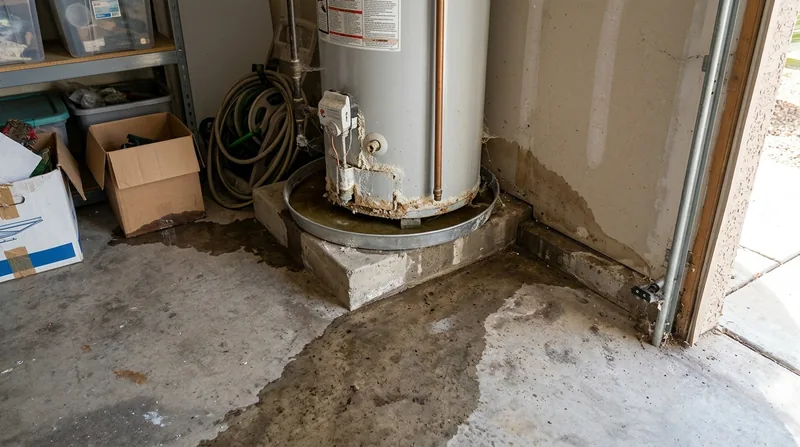




When a water heater leak cleanup in Phoenix starts at 6 a.m., the water is usually already spreading across the garage slab and under the laundry room wall. Hard Valley water wears out tank fittings, ice-maker lines, and dishwasher hoses faster than most homeowners expect, and AC condensate pans overflow every July. Phoenix sits on a flat Salt River Valley floor, so water does not run downhill and disappear. It pools against stucco walls, wicks into baseboards, and creeps under tile and laminate in single-story ranches on slab-on-grade foundations. We are a local, independent restoration company, fully insured, and we document every loss with moisture readings, thermal imaging, and a written drying log. If your appliance failed today, call (623) 255-1819 and we will tell you what the water is likely doing before we arrive. For the extraction step that usually comes first, see our emergency water removal and extraction service.
Why Appliance Leaks Hit Phoenix Homes Harder Than Most Owners Expect
Phoenix water is hard, and that calcium load is brutal on water heater tanks, supply valves, and the plastic lines behind refrigerators. Add summer attic temperatures that push AC condensate lines to failure and you get a predictable pattern of losses across the Valley. A slow refrigerator line leak behind a cabinet can run for weeks before a homeowner notices a buckled toe-kick. A water heater flood in a garage often reaches the adjacent bedroom carpet before anyone smells it. The desert climate also dries surfaces fast while trapping moisture under tile and inside walls, which is why we rely on moisture mapping and thermal imaging cameras rather than a hand on the drywall.
- Hard water scales tank fittings and shortens water heater life in older Phoenix, Mesa, and Glendale neighborhoods.
- Upstairs laundries in newer Gilbert and Chandler two-story homes send water down through the ceiling below.
- AC condensate pans overflow in summer when drain lines clog with dust and algae.
- Dishwasher hoses and ice-maker lines fail quietly under cabinets and behind toe-kicks.
Each of these failures produces Category 1 clean water at the source, but it can turn into Category 2 grey water once it sits in a cabinet or under a floor for a day or two.
Key info: A water heater in an Arcadia garage that let go overnight sent water under the wall plate into a red-brick ranch bedroom. The carpet looked dry on top, but the pad read saturated at the tack strip. Extraction and four days of drying saved the carpet and the baseboards.
For official guidance on water heater maintenance and permits when a unit is replaced, the City of Phoenix provides resources at phoenix.gov.
How We Dry Cabinets, Floors, and Walls After an Appliance Leak in Phoenix
We start by naming the category and class of the loss, because a clean-water dishwasher leak in a Tempe condo is a different job from a refrigerator line that soaked a laminate floor for a month. We take psychrometric readings (temperature, relative humidity, grains per pound) and map moisture with meters and a thermal camera before we move any equipment. Then we set a drying goal and log the numbers until the materials reach it. Equipment comes out when the readings say so, not on a fixed calendar.
- We shut off the source or confirm it is off, then extract standing water from the floor and cabinet base.
- We map moisture in the subfloor, baseboards, toe-kicks, and any wall cavity the water reached.
- We set air movers and LGR dehumidifiers sized to the class of loss and the cubic footage.
- We remove or float the toe-kick and drill small drying holes where a cabinet base traps water.
- We log readings daily and photograph each step for your records.
- We write a scope of work before any drywall or cabinet repair begins.
When the drying is verified, we hand off the rebuild to partner crews and coordinate with the plumber who fixes the appliance line itself.
Key info: A Scottsdale condo dishwasher leak soaked the cabinet base and the tile grout line. We floated the toe-kick, drilled the cabinet base, and dried it in three days instead of cutting out a $4,000 cabinet run. The homeowner kept the cabinets. See how we handle water mitigation and structural drying.
Drying Approaches We Use Around Appliances in Phoenix Homes
Not every appliance leak needs the same equipment. A water heater flood in a garage with a slab floor may need extraction and air movement only, while a refrigerator line leak behind a cabinet in a Chandler kitchen needs contained drying with controlled airflow. The table below shows how we match the approach to the loss.
| Approach | Description | Best for |
|---|---|---|
| Extraction and open drying | Remove standing water, set air movers, and dry with natural ventilation where the space allows. | Garage water heater floods on slab with no drywall contact. |
| Contained cabinet drying | Float toe-kicks, drill small holes, and direct airflow into the cabinet base with a dehumidifier nearby. | Dishwasher and under-sink leaks in Phoenix and Tempe kitchens. |
| Wall cavity drying | Use a flood cut or injection drying when water has wicked up the drywall above the baseboard. | Refrigerator line leaks and AC condensate overflows that reached the wall. |
| Ceiling and floor assembly drying | Open the ceiling below an upstairs laundry or extract under floating floors and dry the subfloor. | Upstairs washer leaks in Gilbert and Chandler two-story homes. |
We choose the least invasive method that the readings support, and we tell you when a small clean-water leak needs only extraction and a few days of drying.
Water Heater, AC & Appliance Leak Cleanup Cost in Phoenix: What to Expect
Most appliance leak cleanups in the Valley start with extraction and drying, and our pricing begins from $295 for a small, contained loss. That figure covers the initial response, moisture mapping, and the start of drying. The final number depends on the category of water, the class of the loss, the square footage affected, and the materials involved. A water heater flood in a garage slab is usually on the lower end. A refrigerator line leak that soaked a cabinet run and a laminate floor moves up quickly because cabinet drying and floor removal take more time and equipment.
We give you a written scope before work begins, and we do not treat demolition as the default. If your loss is small and clean, we will say so. For a fuller breakdown of how we price extraction, drying, and repair, see our pricing overview. Getting two or three estimates is smart, and any honest company should be willing to explain the readings behind its scope.
What to Look For When Hiring Appliance Leak Cleanup Near Phoenix
When you search for water heater leak cleanup near me, you will find national franchises with call centers and pay-per-call networks that sell your number to whoever buys it. A local company should show you its process instead. Ask whether the crew takes moisture readings and logs them, names the category and class of the water, and provides a written drying log with photos. Ask for proof of insurance, and ask who does the repair work if a cabinet or a section of drywall has to be replaced.
We are fully insured, and reconstruction is carried out by partner crews who hold whatever state or local license the work requires. We do not perform plumbing repair on the failed line or HVAC repair on the AC unit; we coordinate with the plumber or technician who does. Coverage decisions are made by your insurance company, and we help document the loss with photos, readings, and a written scope. If you want to talk through your situation, contact us for a free estimate.
Water Heater, AC & Appliance Leak Cleanup in Phoenix: Pricing Guide
| Service | Price | Details |
|---|---|---|
| Small contained appliance leak | Starting at $295 | Includes initial response, moisture mapping, extraction, and start of drying for a small clean-water loss. |
| Water heater flood in garage | Starting at $650 | Covers extraction across the slab and adjacent room, air movers, and daily drying logs. |
| Dishwasher or under-sink cabinet leak | Starting at $850 | Includes contained cabinet drying, toe-kick float, and dehumidification sized to the space. |
| Refrigerator line or AC condensate wall loss | Starting at $1,200 | Covers wall cavity drying, possible flood cut, and thermal imaging to confirm the moisture boundary. |
| Complex or large-scale job | On estimate | Multiple rooms, upstairs laundry, or Category 2 water needs an on-site look before a number is given. |
| Estimate | Free | Response within 24 hours at (623) 255-1819, no obligation to book. |
Indicative pricing, the exact cost depends on square footage, finish, and site access. Free personalized estimate within 24h at (623) 255-1819.