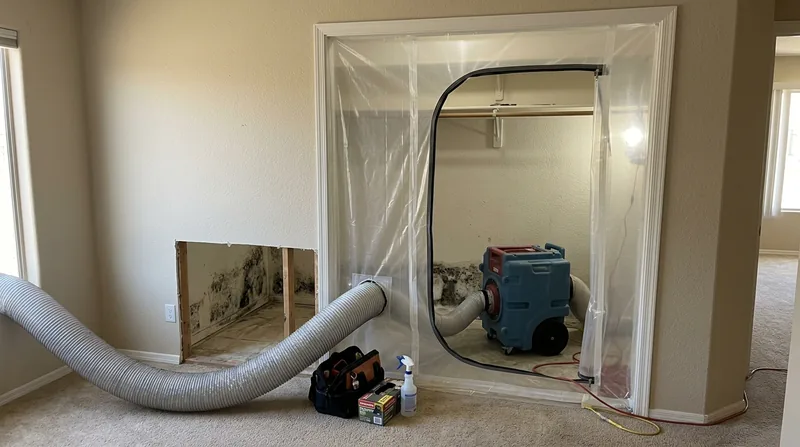




Mold does not wait for a convenient moment. In Phoenix, a pinhole leak in a copper line under a slab, a condensate line from a rooftop AC unit, or a water heater sweating in a garage can wet the same drywall and baseboard for days before anyone notices. Mold remediation in Phoenix starts with one hard fact: mold can begin to colonize wet building materials within 24 to 48 hours, even in desert heat. Our job is to stop the moisture source, contain the affected area, remove what cannot be saved, and verify with readings that the structure is dry. We are a local, independent company, fully insured, and we document drying to IICRC S500 standards. If you are standing in a hallway that smells musty after a leak, call (623) 255-1819 and we will tell you what we see. For the extraction and drying step that comes before mold work, see our water mitigation and structural drying page.
Why Mold Follows Water Damage So Quickly in Phoenix Stucco and Slab Homes
Phoenix homes are built to shed heat, not to dry out slowly. Single-story stucco-and-tile ranches sit on slab-on-grade foundations with copper or PEX lines buried under the slab, and newer two-story subdivisions put laundries and water heaters upstairs. When a supply line fails or an AC condensate line clogs, water wicks into textured drywall, baseboards, toe-kicks, and the subfloor. The desert air outside is dry, but the inside of a wall cavity stays damp for weeks. That is where mold grows.
- Slab leaks and hidden leaks under tile or laminate keep the bottom plate and drywall wet without a visible puddle.
- Upstairs laundry rooms in Gilbert and Chandler two-stories send water down through the ceiling below, wetting insulation and framing.
- Garage water heaters crusted by hard water fail at the tank seam and soak the adjacent wall and stored contents.
- Monsoon-driven roof leaks and AC condensate overflows wet the same ceiling drywall over and over before a stain appears.
The pattern is consistent: the water event ends, the materials stay wet, and the mold colony starts. That is why we treat mold as a building problem that follows moisture, not a mystery.
Key info: A slow slab leak in an Arcadia red-brick ranch can wet the baseboard and drywall for a month before the floor feels soft. By then, the mold has already started on the paper facing of the drywall. The earlier the moisture is found, the smaller the remediation.
For the official guidance on moisture and mold in buildings, the U.S. Environmental Protection Agency publishes a plain-language guide at epa.gov/mold. It is worth reading before you hire anyone.
How We Do Mold Removal After Water Damage in Phoenix, Step by Step
Mold removal after water damage is not a spray-and-wipe job. We start by finding the moisture that fed the mold, because remediation without fixing the source is wasted work. We use moisture meters and a thermal imaging camera to map the wet zone, then we set containment and negative air so spores do not travel to the rest of the house. Only then do we remove what is colonized.
- We document the source and take moisture readings in every affected room, and we write them into a drying log.
- We build containment with poly and negative air machines, and we HEPA-vacuum surfaces before any demolition.
- We remove moldy drywall, baseboard, insulation, and any porous material that cannot be cleaned, making a clean flood cut where needed.
- We clean and antimicrobial-treat the framing and remaining surfaces, then HEPA-vacuum again.
- We dry the cavity with air movers and dehumidifiers and log psychrometric readings until the moisture content matches a dry reference.
- We photograph every step and give you a written scope before any reconstruction begins.
When the job is done, you get the readings, the photos, and a clear record of what was removed and why. That record matters if you ever sell the home or need to document the loss.
Key info: In a Midtown condo tower, a failed supply line behind a bathroom wall soaked the unit below. We contained the lower unit, removed the moldy ceiling drywall, and dried the framing while the HOA coordinated access. The readings showed the framing was dry before we closed anything up.
If the mold started from a sewage backup rather than a clean supply line, the category of water changes the scope. See our sewage cleanup and backup restoration page for that work.
Mold Remediation Methods We Use in Phoenix Homes
Not every mold job is the same size. A small area of drywall behind a water heater in a Sun City garage is a different scope from a two-story Gilbert home with mold in the upstairs laundry and the ceiling below. We match the method to the moisture map, the materials, and the square footage.
| Approach | Description | Best for |
|---|---|---|
| Containment and negative air | Poly barriers and HEPA-filtered negative air machines keep spores in the work zone. | Any job where mold is disturbed, especially in occupied homes. |
| Removal of porous materials | Moldy drywall, baseboard, insulation, and carpet pad are bagged and removed. | Drywall and framing wetted by Category 2 or 3 water, or long-standing leaks. |
| Surface cleaning and HEPA vacuuming | Framing and hard surfaces are HEPA-vacuumed and antimicrobial-treated. | Mold on studs, plates, and other cleanable structural surfaces. |
| Structural drying after remediation | Air movers and LGR dehumidifiers dry the cavity, with psychrometric readings logged. | Every job, because mold returns if the moisture is not verified dry. |
| Contents pack-out | Furniture, clothing, and documents are packed out and cleaned off site. | Rooms where contents block containment or hold odors. |
Each method has a place, and we tell you which ones your job actually needs before we start.
Mold Remediation After Water Damage Cost in Phoenix: What to Expect
Mold remediation pricing in Phoenix starts from $1,200 for a small, contained area, such as drywall behind a water heater or a section of ceiling below an upstairs laundry. From there, the number moves with the category of water, the class of the loss, the square footage affected, and the materials involved. A Category 1 supply line leak caught early is a smaller scope than a Category 3 sewage backup that soaked into a subfloor.
Factors that move the price up include the size of the containment, how much drywall and insulation must be removed, whether cabinets or flooring are affected, and whether contents need a pack-out. Access matters too: a condo in a Midtown tower with an HOA coordination requirement takes more setup than a single-story ranch in Peoria. We give you a written scope before work begins, and we do not treat demolition as the default. A small clean-water leak caught early may need only extraction and a few days of drying.
Getting two or three estimates is smart. Ask each company what category of water they are treating, how they will verify the structure is dry, and whether the price includes the rebuild or stops at remediation. Our pricing overview lays out the ranges so you can compare like with like.
What to Look For in a Mold Remediation Company Near Phoenix
When you search for mold remediation near me, the results can look identical. They are not. A local, independent company will show you its process: moisture readings taken and logged, the category and class of the water named, a written drying log, and equipment removed only when the numbers say so. A call center or a pay-per-call network will not have that record.
- Ask whether the company is fully insured and request a certificate before work starts.
- Get two or three written estimates and compare the scope, not just the total.
- Ask for references from jobs in Phoenix, Mesa, or Scottsdale similar to yours.
- Ask who pulls any permit the rebuild requires; reconstruction is carried out by partner crews who hold the license the work requires.
- If you live in an HOA, ask how the company handles containment, access, and documentation for the board.
A company that answers these questions plainly is the one to hire. If you want to talk through your situation, our contact page is the place to start.
Key info: Mold work is carried out to the rules that apply in the state. We document the moisture source and the readings, and the parties and their insurers decide who is responsible. Coverage decisions are made by your insurance company.
Mold Remediation After Water Damage in Phoenix: Pricing Guide
| Service | Price | Details |
|---|---|---|
| Small contained mold area | Starting at $1,200 | Includes containment, removal of affected drywall or baseboard, HEPA vacuuming, and antimicrobial treatment of a small area. |
| Multiple rooms or ceiling cavity | Starting at $2,800 | Covers larger containment, removal of wet insulation and drywall, and structural drying with logged psychrometric readings. |
| Mold after sewage or Category 3 water | Starting at $4,500 | Includes removal of contaminated porous materials, disinfection, and drying; price moves with square footage and subfloor involvement. |
| Contents pack-out and cleaning | Starting at $600 | Furniture, clothing, and documents packed out, cleaned, and stored; price depends on volume and item count. |
| Complex or large-scale job | On estimate | Needs an on-site moisture map and written scope before a number is given, especially for condos and HOA properties. |
| Estimate | Free | No-obligation written scope with readings and photos; call (623) 255-1819 to schedule. |
Indicative pricing, the exact cost depends on square footage, finish, and site access. Free personalized estimate within 24h at (623) 255-1819.