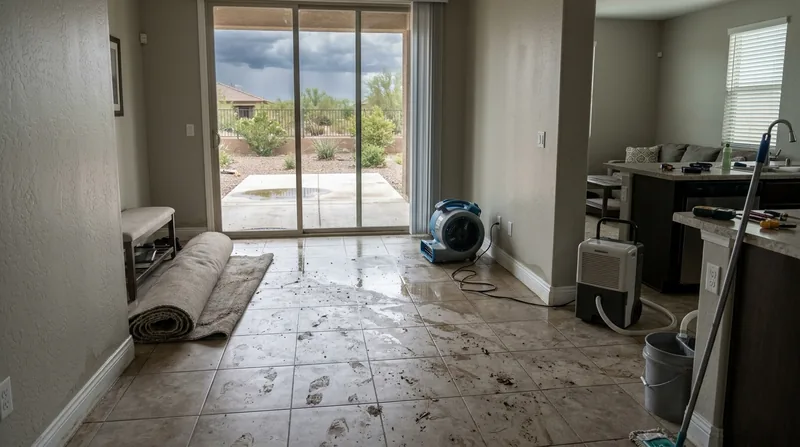




Flood Damage Restoration & Monsoon Cleanup in Phoenix
Phoenix sits in the flat Salt River Valley, where a monsoon cell can drop an inch of rain in under an hour and send it running across hard caliche soil straight into your sliding-door tracks. Flood damage restoration in Phoenix is not about rivers overflowing. It is about water stacking against stucco walls, pushing under doors, and finding every gap in a slab-on-grade ranch or a two-story subdivision. We extract that water, remove the silt and debris, cut out what cannot be saved, and dry the structure with readings you can read. Since 2017 we have worked these streets, from Arcadia red-brick ranches to Midtown condo towers. If you are standing in a wet hallway right now, call (623) 255-1819 and we will tell you what we see.
Monsoon season runs roughly June through September, and the failure mode is always the same: flat and low-slope roofs with AC units and condensate lines, block walls that channel runoff, and desert washes that fill faster than the storm drains. Once water is inside, the clock is on the materials, not on the calendar. Tile floors hold water at the grout lines, carpet wicks up the tack strip, and the bottom plate of a textured drywall wall starts pulling moisture within hours. We document what we find with moisture meters and a thermal imaging camera before we move a single air mover. For the extraction step itself, see emergency water removal and extraction.
Why Monsoon Flooding Hits Phoenix Homes Differently
The Valley gets its water in bursts, and the building stock is not designed for standing water at the door. Slab-on-grade foundations mean there is no crawl space to absorb a mistake, so water that gets under tile or laminate has nowhere to go but sideways into the next room. Stucco walls are dense and slow to release moisture once the paper backing and framing take it on. Hard water from a monsoon puddle leaves silt in the grout and behind the baseboards that a shop vac will not pull out.
- Runoff crosses hard caliche and enters through sliding-door tracks, garage doors, and weep screeds at the stucco line.
- Flat and low-slope roofs pond water around AC units and condensate lines, then leak at the penetration.
- Block walls and desert washes redirect storm flow into yards and against the house in minutes.
- Condo towers in Midtown and the Biltmore push water down shared walls and into the unit below.
- Older Arcadia and Encanto ranches have original cast iron and copper lines that fail under pressure swings.
None of these are exotic failures. They are the ordinary way water gets into a Phoenix house, and each one leaves a different moisture pattern on the meter.
Key info: A storm that floods a driveway in Ahwatukee may leave Gilbert dry, and a two-story stucco subdivision in Queen Creek can take water at the upstairs laundry while the first floor stays clean. We map the moisture room by room instead of assuming the wet spot is the whole story.
For the official record on storm preparedness and local floodplain maps, the City of Phoenix and Maricopa County publish resources through phoenix.gov.
How We Run a Monsoon Flood Cleanup in Phoenix
We start by naming the water. Storm runoff that crossed a yard or a street is Category 2 grey water at best, and water that touched soil, sewage, or a wash is Category 3 black water. That category decides what gets cleaned and what gets cut. Then we classify the loss from Class 1 to Class 4 based on how much water is in the materials and how much evaporation load the building carries. A tile floor over a slab dries differently than carpet and pad in a carpeted bedroom, and the drying log reflects that.
- We photograph the entry points and take initial moisture readings and psychrometric readings (temperature, relative humidity, grains per pound) before extraction.
- We extract standing water, pull silt and debris, and remove carpet, pad, and baseboards where the category or the readings call for it.
- We set air movers and LGR or desiccant dehumidifiers, build containment and negative air where needed, and log readings daily against a written drying goal.
- We remove equipment only when the meter and the log say the materials reached the goal, then write the scope for repair and reconstruction.
The drying log is the part homeowners never see from a call-center crew, and it is the part that matters when you are deciding whether the wall is actually dry.
Key info: In a Chandler two-story, monsoon water came in at the upstairs sliding door and ran down the shared wall into the downstairs ceiling. We opened a flood cut at the ceiling line, dried the framing with readings over four days, and handed the drywall repair to the rebuild scope. The pipe or roof repair that let the water in is a plumber or roofer job, and we say so up front.
When the loss needs more than extraction, the next step is water mitigation and structural drying with the same readings and log.
Approaches We Use on Flood and Monsoon Losses
| Approach | Description | Best for |
|---|---|---|
| Extraction and silt removal | We pull standing water and the fine sediment that monsoon runoff leaves in grout and behind baseboards. | Category 2 storm water on tile, laminate, and concrete. |
| Flood cut and material removal | We cut drywall to the water line and remove wet insulation, pad, and baseboards so air reaches the framing. | Category 3 water and saturated walls. |
| Containment and negative air | We seal the work area and run HEPA filtration with negative pressure to keep debris out of clean rooms. | Sewage backups and any loss with visible mold. |
| Desiccant or LGR drying | We match the dehumidifier type to the psychrometric readings and the class of the loss. | Class 3 and Class 4 losses with dense materials. |
| Antimicrobial application | We apply antimicrobial to affected framing and framing cavities after cleaning, not as a substitute for drying. | Category 2 and 3 losses after removal. |
Flood Damage Restoration & Monsoon Cleanup Cost in Phoenix: What to Expect
Pricing starts from $1,500 for a small storm loss with limited extraction and a few days of drying. That figure moves with the category of water, the class of the loss, the square footage, and the materials involved. A garage that took two inches of runoff and a tiled hallway that needs extraction and drying is a different job than a carpeted living room with saturated pad and a flood cut on two walls. We do not quote a firm number over the phone because the readings decide the scope.
Two or three estimates is the right move on any flood loss. Ask each company what category and class they assigned, whether they will provide a written drying log, and what the scope includes for removal versus drying. A number with no readings behind it is a guess. The full pricing overview breaks down the ranges we work from, and the on-site estimate is free.
What to Look For When Hiring a Water Damage Restoration Company Near Phoenix
Ask whether the company is fully insured and whether the crew that shows up is theirs or a subcontractor dispatched from a call center. Ask for moisture readings before any equipment is set, and ask what the drying goal is. On a flood loss, the difference between a company that documents and one that does not shows up months later in the framing and the drywall. We are a local, independent company, and we show the process because that is the part you can check.
- Confirm the company carries insurance and can provide a certificate on request.
- Get two or three estimates and compare the category, class, and scope, not just the total.
- Ask for references from similar losses in your part of the Valley.
- Ask who pulls permits for any reconstruction and whether the rebuild crew holds the license the work requires.
- Check HOA rules for condo and townhome losses before materials are removed from common walls.
If the answers are vague, keep looking. If you want to talk through your loss, contact us and we will walk the property and put the readings in writing.
For a neighborhood-level view of how monsoon losses play out, see our Scottsdale flood damage page.
Flood Damage Restoration & Monsoon Cleanup in Phoenix: Pricing Guide
| Service | Price | Details |
|---|---|---|
| Small storm loss, extraction and drying | Starting at $1,500 | Covers extraction, initial readings, and a few days of drying in a limited area. |
| Category 2 flood loss with removal | Starting at $3,200 | Includes flood cut, removal of wet pad and baseboards, containment, and logged drying. |
| Category 3 sewage or wash water | On estimate | Requires containment, negative air, and full removal scope before any drying number is set. |
| Large or multi-room loss | On estimate | Square footage, material type, and class of loss decide the equipment count and duration. |
| Estimate | Free | On-site readings and a written scope at (623) 255-1819, no obligation to book. |
Indicative pricing, the exact cost depends on square footage, finish, and site access. Free personalized estimate within 24h at (623) 255-1819.