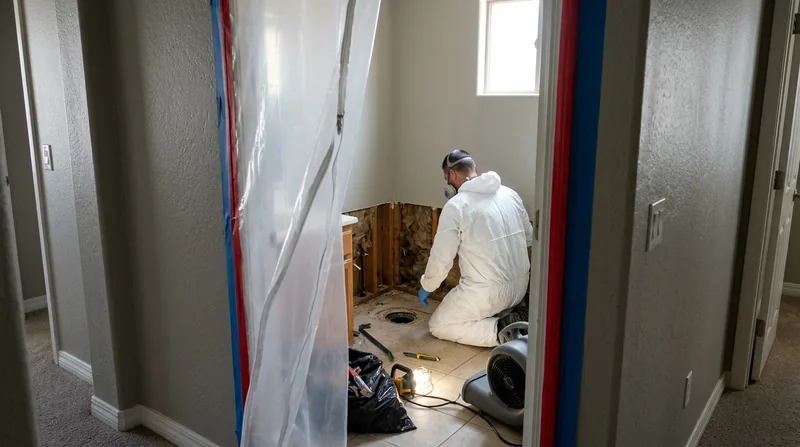




A toilet that backs up at 6 a.m. in a Gilbert ranch or a floor drain that gurgles in a Midtown condo tower is not the same job as a clean supply line leak. Sewage cleanup in Phoenix starts with one fact: the water is Category 3, black water, and it carries whatever was in the drain line. We are a local, independent restoration company working the Salt River Valley since 2017, and our job is to remove what is contaminated, clean and disinfect what stays, dry the structure with readings you can see, and hand you a written scope before anyone rebuilds. You can see how we handle the clean-water side of the same work on our emergency water extraction page. On this page we talk only about sewage backups, toilet overflows and black water.
Why Sewage Backups Hit Phoenix Homes Harder Than Most Homeowners Expect
Phoenix sits on flat, hard ground, and most of the housing stock is slab-on-grade stucco and tile. When a main line backs up, the water does not disappear into a basement or a crawl space. It spreads across tile, wicks into the carpet tack strip, and climbs the bottom inch of drywall in a hallway before anyone notices. In the older red-brick ranches around Arcadia and Encanto, cast iron and clay drain lines have had decades of hard water and roots working on them, and in newer two-story subdivisions in Chandler and Gilbert the upstairs laundry drain is a common source. The monsoon season adds its own pressure: saturated soil and sudden volume on aging laterals push backups into the lowest fixture in the house, usually the downstairs toilet or the shower pan.
- We treat every backup as Category 3 until the source proves otherwise, because a drain line is never clean water.
- We pull moisture readings and thermal images of the wet wall and floor assembly, not just the visible puddle.
- We remove what cannot be cleaned (carpet, pad, saturated drywall, baseboards) and keep what can, instead of tearing out a whole room by default.
- We set containment and negative air when the loss crosses a doorway or a return-air path.
- We log temperature, relative humidity and grains per pound every day so the drying goal is a number, not an opinion.
That is the difference between a mop and a documented sewage damage restoration job. If you want the official reference behind the drying side, the EPA's sanitary sewer overflow guidance explains why sewage is handled as contaminated water, not a spill.
Key info: A backup in a 1950s Arcadia ranch with a slab floor and original cast iron is a different scope than a 2018 Gilbert two-story with PEX and an upstairs laundry. Same Category 3 water, very different demolition and drying plan.
How We Run a Sewage Backup Cleanup in Phoenix, Step by Step
We start by stopping the source, or by confirming that a plumber has stopped it. The pipe is not ours to fix, and we say so plainly: we coordinate with a plumber you choose or one we can refer, and we do not touch the drain line itself. Once the flow is stopped, the work is a sequence, and each step has a reading or a photo attached to it.
- We scope the loss, name the category and class, and photograph every affected surface before anything moves.
- We extract standing black water with a truck-mount or portable unit and HEPA vacuum the debris that remains.
- We remove contaminated materials: carpet, pad, drywall to a flood cut above the wicking line, baseboards and toe-kicks in cabinets.
- We clean and disinfect hard surfaces with an antimicrobial, then verify with moisture readings before we close anything.
- We set air movers and LGR dehumidifiers, and we log psychrometric readings daily until the assembly reaches the drying goal.
- We write the scope for the rebuild, and the reconstruction is carried out by partner crews who hold the license the work requires.
For a typical condo backup in Midtown Phoenix, that also means coordinating with the HOA and the unit below, because water travels through a shared slab. Our condo and HOA water damage page covers how that coordination works.
Key info: A toilet overflow in a Scottsdale guest bath that soaked a small tile floor and the bottom of one wall is often a two-to-three day dry with a limited flood cut. A main-line backup that ran across 600 square feet of carpet in a Peoria ranch is a removal and rebuild job. We scope both before we quote either.
Approaches We Use for Black Water Cleanup and Sewage Damage Restoration
Not every backup gets the same treatment. The category of water, the class of the loss and the materials decide the method, and we choose it after the readings, not before.
| Approach | Description | Best for |
|---|---|---|
| Containment and removal | Negative air and plastic barriers isolate the room; contaminated carpet, pad and drywall come out and leave bagged. | Any Category 3 loss that crosses a doorway or shares return air |
| Flood cut and disinfection | Drywall is cut above the wicking line, framing is cleaned and treated with antimicrobial, then dried. | Toilet overflow cleanup where water climbed painted drywall |
| HEPA vacuum and hard-surface wash | Tile, slab and cabinet toe-kicks are HEPA vacuumed, washed and disinfected before drying equipment goes down. | Bathrooms, laundry rooms and utility closets on slab |
| Documented structural drying | Air movers and LGR dehumidifiers run against a written drying log with daily psychrometric readings. | Every sewage damage restoration, with or without visible water |
| Contents pack-out | Salvageable contents are inventoried, removed and cleaned off site while the structure dries. | Bedrooms and closets next to a backed-up bathroom |
Each method is chosen for a reason, and the reason is written into the scope before the first air mover is placed.
Sewage Cleanup & Backup Restoration Cost in Phoenix: What to Expect
Most sewage backup cleanups in Phoenix start from $750, and that floor covers a contained loss: extraction, removal of contaminated materials in a small area, disinfection and a short drying cycle. The number moves with the category of water, the class of the loss (how much water and how much evaporation load), the square footage, and the materials involved. A tile bathroom dries differently from a carpeted hallway with a wood subfloor, and a flood cut in a textured drywall wall adds removal and replacement. We do not quote a firm price over the phone, because nobody can price a Category 3 loss without seeing the wicking line and taking readings. We do give you a written scope and a range after the walkthrough, and you can compare it against the detail on our pricing page. Getting two or three estimates on a job this size is smart, and we expect it.
Sewage Cleanup & Backup Restoration Near Me: What to Check Before You Hire
When you search for sewage cleanup near me in Phoenix, the list you get is a mix of local companies, national franchises and pay-per-call networks that sell your number to whoever buys it. Ask who will actually walk the loss. A company that takes moisture readings, names the category and class, and hands you a written scope before demolition is the one to hire. Also confirm insurance: we are fully insured, and we can provide a certificate on request. Reconstruction work is carried out by partner crews who hold whatever state or local license the work requires. Ask for references from a similar Phoenix job, and if you are in an HOA, check the rules on dumpsters, parking and working hours before the crew arrives. Coverage decisions are made by your insurance company, and we help by documenting the loss with photos, readings, a drying log and a written scope. Call our contact page at (623) 255-1819 to set up the walkthrough.
Sewage Cleanup & Backup Restoration in Phoenix: Pricing Guide
| Service | Price | Details |
|---|---|---|
| Contained toilet overflow cleanup | Starting at $750 | Extraction, removal of contaminated materials in a small area, disinfection and a short drying cycle. |
| Sewage backup with flood cut | Starting at $1,450 | Drywall cut above the wicking line, framing cleaned and treated, plus documented structural drying. |
| Multi-room sewage damage restoration | Starting at $2,900 | Containment, removal across several rooms, HEPA vacuuming, disinfection and a full drying log. |
| Contents pack-out and cleaning | Starting at $450 | Inventory, removal and off-site cleaning of salvageable contents while the structure dries. |
| Complex or large-scale job | On estimate | Category 3 losses that cross units or involve shared slabs need an on-site look before a number. |
| Estimate | Free | Walkthrough, moisture readings and a written scope at (623) 255-1819, no obligation to book. |
Indicative pricing, the exact cost depends on square footage, finish, and site access. Free personalized estimate within 24h at (623) 255-1819.