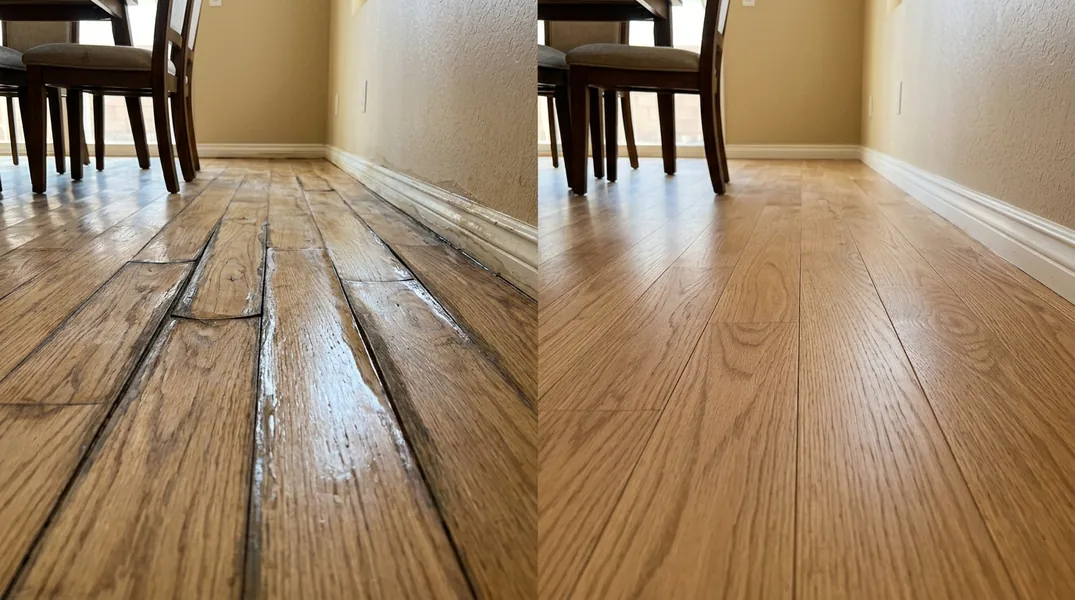
Condo Water Damage From an Upstairs Neighbor: The Short Answer
When water leaks from the unit above yours, the honest answer to "who pays?" is that it depends on three things: where the leak started, what it damaged, and what your condo documents say. In most cases, the upstairs owner's insurance or the HOA's master policy covers the source and the structural repairs, while your own HO-6 policy covers your personal belongings and interior finishes. But the details matter, and the only way to protect yourself is to document everything from the first drop.
What we see most often in Phoenix condos is a supply line, a water heater, or an AC condensate line in the unit above that fails quietly. By the time the stain shows on your ceiling, the water has usually been traveling for hours or days. The first step is not to argue about fault. It is to stop the source, get the water out, and start a written record. That record is what the parties and their insurers will use to sort out responsibility later. We do not give legal advice about who is responsible between neighbors or an HOA. We document the source and the readings, and the parties and their insurers decide.
What Your Condo Documents and Insurance Actually Cover
Every condo association has a governing document that spells out who maintains and insures what. Some HOAs cover the drywall and framing inside units, some stop at the studs, and some cover nothing inside the unit at all. Your HO-6 policy typically covers your personal property, your flooring, and any interior improvements you made. The upstairs neighbor's policy usually responds to the source of the leak and the damage it caused. The HOA master policy handles common areas and the building structure as defined in the documents.
Read your CC&Rs and your HO-6 policy before you assume anything. If you are a renter, your renters policy and your landlord's policy both come into play, and the HOA rules still apply. The key takeaway is that coverage decisions are made by your insurance company, not by us and not by your neighbor. What we can do is give you the documentation your insurer will ask for: photos of the source and the damage, moisture readings taken and logged, the category and class of the water named, and a written drying log. That package is what helps a claim move forward, whatever the outcome.
Leak in Condo Ceiling: Who Is Responsible and What to Do First
The moment you see water on your ceiling, the priority is to limit the damage. Move furniture and electronics out of the way, put towels or buckets down, and if the ceiling is bulging, do not poke it. Call the upstairs neighbor and the HOA right away so the source can be shut off. Then call a restoration company to extract the water and start drying. The longer water sits in drywall, insulation, and flooring, the more the loss class grows and the more demolition becomes necessary. A small clean-water leak caught early may need only extraction and a few days of drying. Demolition is never the default.
This is where Emergency Water Removal & Extraction comes in. We extract standing water, take moisture readings, and set drying equipment. We document the category and class of the water, keep a written drying log, and take photos at every step. If the ceiling needs to be opened to dry the cavity, we explain why and show you the readings that justify it. We do not fix the pipe itself. Plumbing repair is done by a plumber we coordinate with, and the roof, if that is the source, is fixed by a roofer. Our scope is the water and what follows it: extraction, drying, and the repair and reconstruction of what the water damaged.
Water Damage From Upstairs Neighbor: Documenting the Loss
Documentation is the single most useful thing you can do after a condo water loss. Take photos and video of the ceiling, the walls, the floor, and any belongings that are wet. Keep a written timeline of when you noticed the leak, who you called, and when. Save any receipts for temporary repairs or hotel stays. If the HOA or the neighbor sends someone to look, ask for their name and company and write it down. This is not about assigning blame. It is about creating a clear record that your insurer and the other parties can use.
Our part of that record is technical. We take moisture readings and log them, name the category and class of the water, and keep a drying log that shows the numbers going down over time. We do not remove equipment until the readings say the materials are dry. We write a scope before any rebuild begins. If mold is a concern, we describe it as a building problem that follows moisture, not a health crisis, and anyone with health concerns should talk to their doctor. Mold work is carried out to the rules that apply in the state, and if an assessment is needed, it is handled separately from the remediation. Coverage decisions are made by your insurance company, and our documentation is designed to support that process without overstepping it.
Water Mitigation & Structural Drying Near Me: When to Call a Pro
Not every ceiling leak needs a full crew. A slow drip from a supply line that is caught within an hour may be handled with a bucket, a fan, and a call to the plumber. But if the drywall is soft, if the stain is spreading, if the carpet is squishy, or if the leak has been going on for more than a day, call a professional. Water travels through wall cavities and ceiling joists in ways you cannot see, and a moisture meter is the only way to know how far it went. In Mesa and across the Valley, we routinely find that a small ceiling stain hides a much larger wet area above it.
Water Mitigation & Structural Drying is the process of getting the moisture out of the structure and verifying it with readings. That means air movers, dehumidifiers, and a drying log that is updated daily. It also means knowing when to stop. Equipment pulled after two days without numbers is a red flag, whether it is us or any other company. Ask for the readings. Ask for the log. Ask for the scope in writing before any rebuild starts. If a company cannot show you those things, keep looking. You can call Phoenix Water Damage Restoration at (623) 255-1819 to talk through what you are seeing and get a free estimate.
Condo Water Damage Repair & Reconstruction: What Comes After Drying
Once the structure is dry and the readings confirm it, the rebuild begins. That may mean patching drywall, replacing insulation, painting, reinstalling flooring, or repairing a cabinet. This is where a written scope matters most. You should know what is being replaced, what is being dried in place, and what the cost range is before anyone swings a hammer. Our Water Damage Repair & Reconstruction work is carried out by partner crews who hold whatever state or local license the work requires. We are fully insured, and we coordinate the plumber or roofer who fixes the source.
If the leak came from a hidden source, like a slab leak or a line inside a wall, the repair scope may be larger than it first appeared. Slab Leak & Hidden Leak Water Damage often involves drying out adjacent rooms and replacing flooring that was not obviously wet. We give you a range based on the category of water, the class of the loss, the materials, and the square footage, and we put it in writing. Pricing is not a firm number until the scope is known, but you should never be surprised by a bill. If you are in Scottsdale or anywhere in the Valley and want to understand your options, call (623) 255-1819 or request a free estimate. The goal is simple: fix the source, dry the structure with numbers to prove it, and rebuild only what the water actually damaged.
Looking for a professional water damage restoration contractor in Phoenix? Phoenix Water Damage Restoration responds fast for all your water damage restoration needs.
Get a Free Quote