What a Slab Leak Is and Why Phoenix Homes Get Them
A slab leak is a failure in a water line that runs beneath the concrete foundation of your home. In most Phoenix houses, the incoming water supply and sometimes the drain lines are routed through or under the slab, which means a pinhole in a copper pipe or a crack in a fitting can send water into the soil and the concrete for weeks before anyone notices. The leak itself is a plumbing problem, and the pipe is repaired by a plumber we coordinate with, not by us. What we handle is everything the water touches after it escapes: saturated flooring, wicking drywall, wet baseboards, and the moisture that settles into cavities you cannot see.
Phoenix has a few conditions that make slab leaks more common than homeowners expect. The soil here expands and contracts with extreme heat and seasonal irrigation, and that movement puts stress on buried pipes. Many neighborhoods also have older copper systems that have been sitting under hot concrete for decades, and hot water lines in particular corrode from the inside out. Add in the fact that most slabs sit directly on grade with no basement buffer, and a small leak has nowhere to go but up into your flooring and outward into adjacent rooms. Catching the early signs matters because the longer water moves under a slab, the more of the home's finish materials it reaches.
Warning Signs You Should Not Ignore
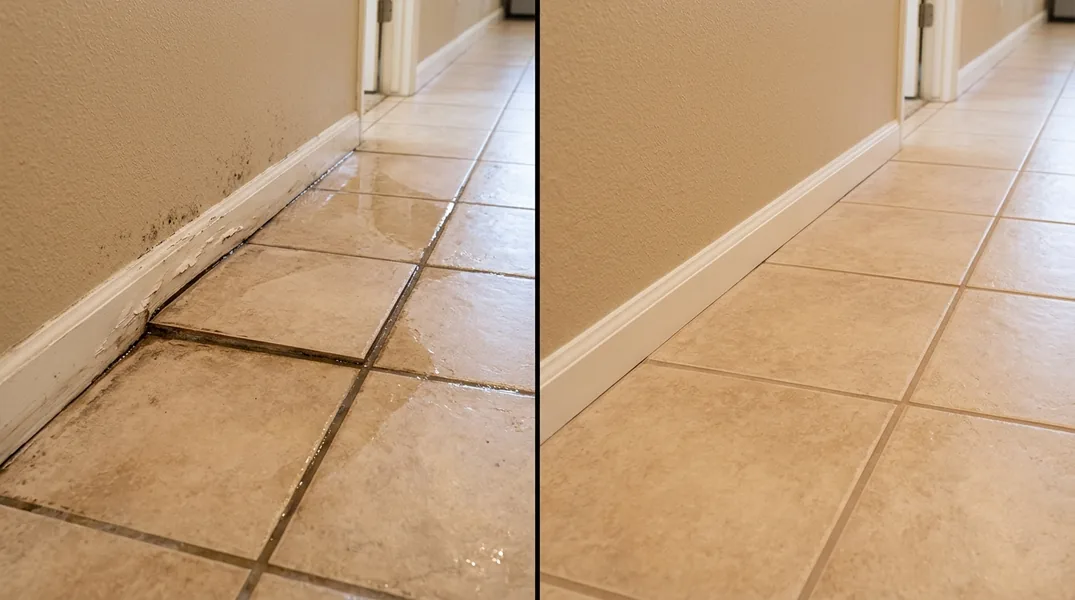
The classic warning signs of a slab leak are easy to dismiss individually but telling when they appear together. You may hear water running when every fixture is off, notice a hot spot on the floor where the hot water line is leaking, or see a water bill climb without any change in habits. Floors can feel spongy or warm, laminate and tile can lift or crack, and baseboards may swell or show a dark line where moisture is wicking up. A musty smell in a room with no obvious source is another signal that moisture is trapped somewhere. None of these signs confirm a slab leak on their own, which is why Slab Leak & Hidden Leak Water Damage work starts with proper detection rather than guesswork.
Detection is the step that saves homeowners the most money. A plumber uses acoustic listening equipment, pressure isolation tests, and sometimes thermal imaging to pinpoint where the line is failing before anyone cuts concrete. On our side, moisture readings map how far the water has traveled into flooring, drywall, and framing, and those readings are logged so you can see the difference between a small contained leak and one that has spread under several rooms. If the readings show a limited area of clean water, the honest answer may be extraction and a few days of drying, not demolition. We tell homeowners that plainly because tearing out flooring that can be dried in place helps no one.
Slab Leak Repair and Water Damage Costs in Phoenix: What to Budget
Homeowners researching slab leak repair pricing should understand that the total usually combines two separate bills: the plumbing repair and the water damage work. The plumbing side depends on how the leak is fixed, whether that is a spot repair, a reroute of the line through the attic or walls, or a tunnel under the slab to avoid breaking the floor. The water damage side depends on the category of water, the class of the loss, the materials affected, and the square footage involved. Clean supply line water is the most straightforward category, while water that has sat long enough to pick up contaminants changes the scope. Because of those variables, any responsible company gives ranges and a written scope after inspecting, never a firm number over the phone.
As a general guide, small losses confined to one room cost far less than leaks that have spread under tile, carpet, and cabinetry across multiple rooms. Drying equipment, daily monitoring, and the removal and replacement of affected materials all factor in. If reconstruction is needed, that is scoped and priced separately so you can see exactly what is repair versus what is rebuild. We provide a written scope before any rebuild begins, and we document moisture readings and photos at every step. For a free estimate, call Phoenix Water Damage Restoration at (623) 255-1819 and we will walk through what we see and what it likely involves.
What Insurance Usually Covers for Slab Leak Water Damage
Insurance questions around slab leaks are common and often misunderstood. Many homeowners policies treat the sudden escape of water from a plumbing system as a covered peril, which means the resulting water damage to floors, walls, and contents may be eligible. The pipe repair itself is frequently excluded or capped, and long-term seepage that a homeowner should have noticed is often treated differently than a sudden failure. Every policy is different, and coverage decisions are made by your insurance company. What we do is help you document the loss thoroughly: photos before and after extraction, moisture readings taken and logged, a written drying log, and a written scope of the affected materials. That documentation is what you hand to your carrier so the claim can be evaluated on facts rather than estimates.
There are a few practical steps that make the documentation stronger. Report the leak to your insurer promptly, keep the plumber's report on where the line failed, and avoid throwing away damaged materials before they are photographed. If your policy includes loss of use or contents coverage, keep receipts and an inventory. We do not file, manage, or negotiate claims, and we never promise that a loss will be covered. We also cannot waive or absorb a deductible. What we can do is make sure the record of what happened in your home is complete and accurate, which is the part homeowners most often lack when they call their carrier.
Slab Leak Water Damage Near Me: When to Call a Professional
Once the plumber has stopped the leak, the water damage work begins, and that is where Emergency Water Removal & Extraction comes in. Standing water and saturated materials need to come out quickly because moisture spreads through framing and subfloor and creates the conditions for mold. Our process starts with moisture readings and a category and class assessment so the drying plan matches the actual loss. We set equipment, log readings daily, and remove equipment only when the numbers show the materials have reached dry standard. If reconstruction is needed afterward, Water Damage Repair & Reconstruction is scoped in writing before work starts. Drying is documented to IICRC S500 standards, and we are fully insured.
Homeowners in Mesa, Scottsdale, and Glendale face the same slab construction and the same heat, so the guidance is the same. If you see signs of a slab leak, get the plumbing side diagnosed first, then have the water damage assessed before materials are replaced. If you are unsure whether you need help, call (623) 255-1819 and describe what you are seeing. We will tell you honestly whether it sounds like a small clean-water leak that needs extraction and drying, or something that needs a fuller scope. Demolition is never our default, and a written scope always comes before any rebuild.
Looking for a professional water damage restoration contractor in Phoenix? Phoenix Water Damage Restoration responds fast for all your water damage restoration needs.
Get a Free Quote