Why Hard Water in Arizona Puts Your Water Heater at Risk
Homeowners across the Valley deal with some of the hardest water in the country. That water carries dissolved calcium and magnesium, and when it sits inside a tank and gets heated day after day, those minerals settle out as scale. Scale coats the heating elements, the tank lining, and the fittings, and it does not stay put. It builds up until metal weakens, valves stop sealing properly, and the tank has to work harder to do the same job. Over time, that wear shows up as a water heater leak, sometimes as a slow drip you barely notice and sometimes as a full water heater flood that spreads across a garage or utility closet floor while you sleep.
Hard water also attacks the connections and the pressure relief valve. Mineral deposits can keep a relief valve from opening or closing cleanly, and sediment at the bottom of the tank traps heat and shortens the life of the unit. None of this happens overnight, which is exactly why it is easy to ignore until water is already on the floor. If you have lived in the same Phoenix home for years without flushing the tank or checking the anode rod, your water heater has likely been telling you something for a while.
Warning Signs of a Water Heater Leak You Should Not Ignore
The earliest signs are usually small. You might see rust-colored water at a hot tap, hear popping or rumbling from the tank as sediment heats, or notice condensation or a faint damp smell around the base of the unit. A puddle that reappears after you wipe it up is a strong signal, even if it is only a few ounces. Look for crusty white mineral deposits around the pipes and fittings, a sign that water has been seeping and evaporating there for a while. If the tank itself is weeping from the bottom, that is often the end of the road for the unit, and the leak will not stop on its own.
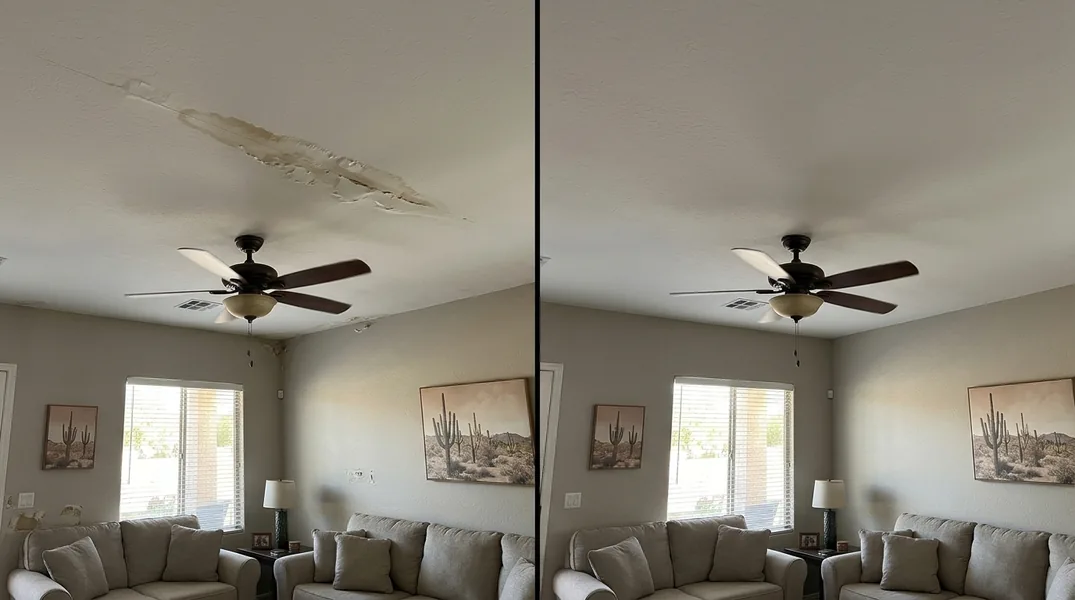
Some signs point to a bigger problem. Water staining on drywall or baseboards near a closet or garage wall, a soft spot in the flooring, or a musty odor in an adjacent room can mean water has been traveling behind finishes for weeks. A water heater leak in a second-floor closet or an attic can soak insulation and ceiling drywall before anyone sees a drip. If you notice any of these, shut off the water supply to the heater and the power or gas, then call a plumber to address the unit itself. Once the source is stopped, the water left behind is a separate job, and that is where a restoration crew comes in.
What a Water Heater Flood Does to a Valley Home
A tank failure can release dozens of gallons in a short time. In a Mesa or Glendale home, that water often lands on tile, laminate, or carpet and wicks up drywall within hours. It seeps under baseboards, into the wall cavity, and into adjacent rooms. In slab-on-grade construction, water finds the lowest point and can sit under flooring for days without visible evidence on the surface. The longer it stays, the more materials it compromises, and the more likely mold becomes a factor, because mold follows moisture wherever it lingers.
This is why the first hours matter more than the first days. A water heater flood that is extracted and dried quickly may only require removing a small section of baseboard and running air movers and dehumidifiers for a few days. One that sits over a weekend can mean saturated subfloor, damaged cabinets, and drywall that has to be cut out. The difference is not drama, it is simply how water behaves in a hot, dry climate where the surface dries fast but the wall cavity stays wet. Our Emergency Water Removal & Extraction team starts by finding the edges of the moisture with meters, not by guessing.
Water Heater Leak Cleanup Near Me: What the Process Looks Like
When you search for water heater leak cleanup near you, you should be able to ask any company what they actually do. Here is what the process looks like when it is done properly. First, the source is confirmed off, usually by a plumber, so water is not reintroduced mid-drying. Then moisture readings are taken and logged at the affected materials, and the water is named by category and the loss by class. Standing water is extracted, wet materials are evaluated, and a drying plan is set with equipment placed according to the readings. The drying is documented to IICRC S500 standards, with a written log and photos at each visit, and equipment stays until the numbers show the materials are dry, not until a set number of days has passed.
If drywall or flooring has to come out, you get a written scope before any rebuild begins. Our Water Mitigation & Structural Drying work is built around those readings and that log, and any Water Damage Repair & Reconstruction is scoped in writing so you know what is being replaced and why. We are fully insured, and reconstruction is carried out by partner crews who hold whatever state or local license the work requires. We do not repair the water heater itself; that is the plumber's job, and we coordinate so the drying and the repair do not get in each other's way. If you are in Scottsdale or anywhere in the Valley and want a free estimate, call (623) 255-1819 and describe what you are seeing.
Hard Water Arizona: Prevention and When to Call for Help
You cannot change the water chemistry coming into your home, but you can reduce the wear. Flushing the tank annually, checking the anode rod every few years, and installing a water softener or whole-home filtration system all help extend the life of the unit. Watch the age of your heater; most tanks have a service life, and a unit past it is a leak waiting to happen. A drip pan under the heater with a drain line to the exterior is a cheap safeguard that can keep a slow leak from becoming a floor replacement. These steps do not guarantee anything, but they stack the odds in your favor.
When water is already on the floor, the question is not whether to call someone but who. Coverage decisions are made by your insurance company, and we help document the loss with photos, moisture readings, a drying log, and a written scope so you have a clear record of what happened. If the leak is under a slab or hidden in a wall, our Slab Leak & Hidden Leak Water Damage work uses the same readings-first approach. For pricing ranges, ask before work begins, and expect the final number to depend on the category of water, the class of the loss, the materials affected, and the square footage. A small clean-water leak caught early may only need extraction and a few days of drying, and we will tell you so. Call Phoenix Water Damage Restoration at (623) 255-1819 to talk through what you are seeing.
Looking for a professional water damage restoration contractor in Phoenix? Phoenix Water Damage Restoration responds fast for all your water damage restoration needs.
Get a Free Quote