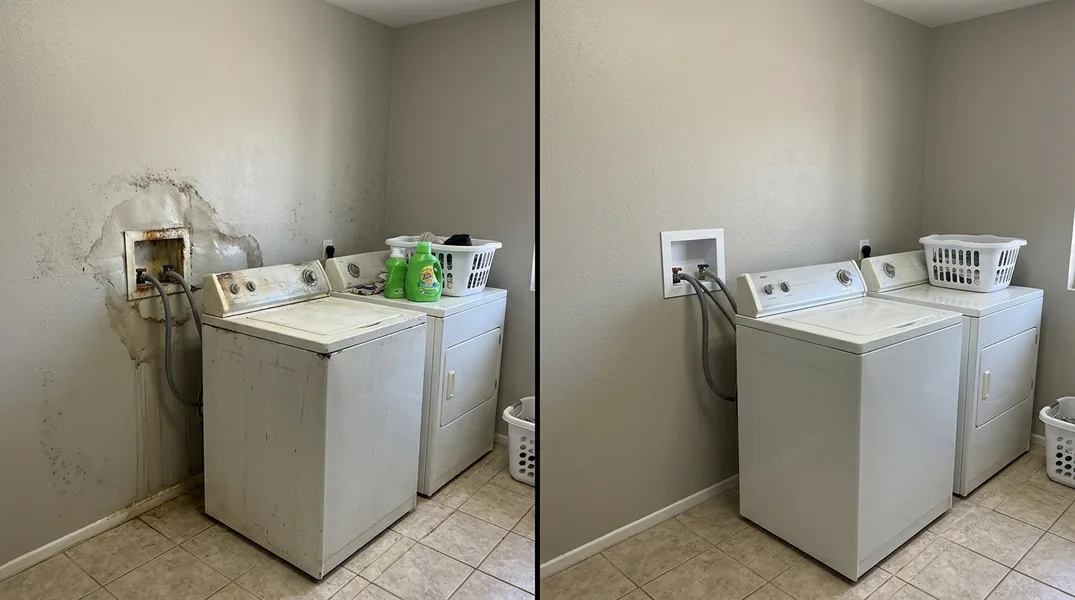
The First Hour After You Find Water: What to Do After Water Damage
Finding water where it does not belong is a stressful moment, and the instinct to grab towels and start mopping is understandable. The first thing to do is stop the source if you safely can. That means shutting off the supply valve under a sink, at the toilet, or at the main shutoff for the house if a pipe has burst. If the water is coming from a roof leak during a storm, you cannot stop the sky, but you can move furniture, rugs, and electronics out of the path and put buckets down. Once the flow is stopped, the clock starts working against you: water wicks into drywall, baseboards, and carpet padding within hours, and the longer it sits, the more material has to be removed later.
Next, document what you see before you clean anything. Take photos and short videos of the standing water, the damaged items, and the source. This matters for your own records and for any insurance conversation later, because coverage decisions are made by your insurance company, not by anyone standing in your hallway. Then call a professional to assess the moisture. A local company like Phoenix Water Damage Restoration can take readings, name the category and class of the water, and tell you honestly whether this is a small clean-water leak that needs extraction and a few days of drying, or something bigger. You can reach them at (623) 255-1819 to talk through what you are seeing.
Signs of Water Damage You Should Never Ignore
Some water damage is obvious: a puddle, a stained ceiling, a squishy carpet. Much of it is not. The signs of water damage that homeowners miss most often are subtle and develop slowly. A faint musty smell in a closet or bathroom, paint that bubbles or peels along a baseboard, a section of drywall that feels soft when you press it, or a laminate floor that has started to cup at the seams are all clues that moisture is present. In Phoenix, where the air is dry most of the year, these signs can be easy to dismiss because the surface feels dry to the touch. The moisture is often inside the wall or under the slab, not on top of it.
Pay attention to your water bill and your water heater, too. An unexplained jump in usage can point to a leak you cannot see, and a water heater that is rusting at the base or leaving a damp ring on the garage floor is telling you something. AC condensate lines are another common culprit in this climate: a clogged line can drip steadily into a ceiling or closet for weeks without anyone noticing. If you spot any of these signs, do not wait for visible damage to appear. A moisture meter reading takes minutes and can confirm whether you have a problem worth addressing now or one you can monitor.
Hidden Water Damage: What You Cannot See Is What Costs You
Hidden water damage is the part of this problem that separates a minor repair from a major reconstruction. Water travels along framing, pools on vapor barriers, and saturates insulation inside walls where no one looks. In slab-on-grade homes common across the Valley, a supply line under the slab can leak for a long time before you notice a warm spot on the floor or a crack that keeps reappearing. That is why Slab Leak & Hidden Leak Water Damage deserves a professional assessment rather than a wait-and-see approach. By the time a stain shows on the ceiling, the drywall above it has usually been wet for a while.
The honest answer to whether you can handle hidden water damage yourself is no, and it is not because the work is exotic. It is because you cannot verify dryness by touch. Professionals use moisture meters and thermal imaging to find wet pockets, and they log readings over several days to prove the structure is drying. Without those numbers, you are guessing, and guessing is how drywall gets closed back over wet framing. If you suspect a hidden leak, the right move is an assessment, not a patch. You can request a free estimate and get a clear picture of what is actually wet.
When You Can Handle It Yourself and When to Call a Pro
There is a real category of water damage a careful homeowner can manage. A small, clean-water leak from a supply line or an appliance, caught within an hour or two, on a hard floor with no wall involvement, is often a matter of extracting the water, running fans and a dehumidifier, and watching the area for a few days. If the water came from a clean source, stayed on the surface, and did not reach drywall, carpet padding, or cabinets, you may be able to handle it. The key is catching it early and being honest with yourself about how far the water traveled.
The moment the situation changes, call a professional. Water that is gray or black (from a toilet overflow, a dishwasher backup, or outdoor flooding) is contaminated and needs proper handling. Water that has soaked into carpet padding, drywall, or insulation needs Water Mitigation & Structural Drying with documented readings, because surface drying will not reach the wet materials. Water that has been sitting for more than a day or two, or that came through a ceiling, or that involves a slab leak, is past the DIY stage. And any water damage that has led to mold growth needs to be handled to the rules that apply in the state, with the assessment and the remediation kept separate. If you are unsure which category you are in, a phone call is cheaper than a mistake.
Emergency Water Removal & Extraction Near Me: What the Process Should Look Like
When you search for Emergency Water Removal & Extraction near me, you will get a mix of national franchises and call-center networks alongside local companies. The difference matters. A franchise is a brand with a call center, and a pay-per-call network is an 800 number that sells your call to whoever buys it. A local independent company shows you its process. That process starts with moisture readings taken and logged, the category and class of the water named out loud, and a written scope before any rebuild begins. Equipment stays until the numbers say the structure is dry, not until a set number of days has passed. Photos are taken at every step.
What you should expect from any restoration company, including this one, is that demolition is not the default. A small clean-water leak caught early may need only extraction and a few days of drying, and an honest company will tell you that instead of selling a rebuild. What you should also expect is clarity about scope: water extraction and drying are the core, and if the pipe itself is broken, that repair belongs to a plumber, and if the roof is the source, that belongs to a roofer. A good restoration company coordinates with those trades rather than pretending to do everything. If the damage extends to materials that need replacing, Water Damage Repair & Reconstruction is the next phase, and it should come with a written scope and photos, not a verbal guess.
Water Damage Repair Cost in Phoenix: What to Budget
Homeowners understandably want a number, and the honest answer is that pricing depends on three things: the category of water (clean, gray, or black), the class of the loss (how much material is wet and how far the water traveled), and the square footage and materials involved. A small clean-water extraction in a bathroom is a different job from a slab leak that has saturated carpet and baseboards across two rooms. Any company that quotes a firm price over the phone without seeing the loss is guessing, and you should be cautious about that.
What you can do is ask for a written scope before work begins and ask how drying will be verified. A legitimate company will explain that equipment stays until readings confirm dryness, and that the scope covers extraction, drying, and any demolition needed to access wet materials. If reconstruction is required, ask for that scope separately. Coverage decisions are made by your insurance company, so keep your photos and documentation organized, and ask your carrier directly about your policy. For a clear picture of what your specific situation might involve, call Phoenix Water Damage Restoration at (623) 255-1819 or request a free estimate. They serve Mesa, Glendale, Scottsdale, and the surrounding communities, and they will tell you honestly whether you are looking at a small drying job or something larger.
Looking for a professional water damage restoration contractor in Phoenix? Phoenix Water Damage Restoration responds fast for all your water damage restoration needs.
Get a Free Quote